Fire Extinguisher Inspection: The Business Behind the Tag
Somebody gets paid to hang that little tag, and they come back every year for as long as the building stands. Here is how that business actually works.
Fire extinguisher inspection is a licensed route business. Technicians perform annual maintenance checks on portable extinguishers, hang a dated tag, and return every year. Federal workplace rules require the checks, most states license the companies that perform them, and once you're on a building's schedule you tend to stay there.
The keys to this article
- OSHA requires employers to have portable fire extinguishers maintenance checked annually, with records kept and available on request.
- Most states require two credentials: a license for the company and a certification for each technician. Neither one alone is enough.
- That licensing is the moat. It's why a handful of small regional firms hold entire metro areas.
- The tickets are small and the route is everything. This business is built account by account over years.
- Hydrostatic testing needs specific equipment, including a protective cage. Most new operators subcontract it, and that's the right call.
- Once you're on a building's annual schedule, switching you out means re explaining an entire property to somebody new. Very few facility managers volunteer for that.
Start with the tag
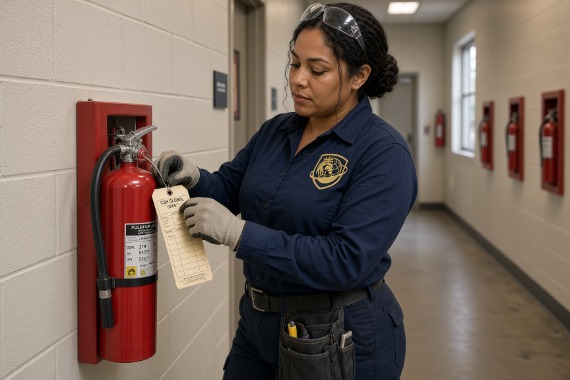
Next time you're waiting for a table, look at the wall behind you.
There's a fire extinguisher there, and hanging off it is a small paper tag. Punched holes down one side, a signature, a date. You've walked past thousands of them and never once thought about it, which puts you in excellent company.
Somebody drove to that restaurant, checked that unit, signed that tag and got paid. Then they did the same thing at the dry cleaner two doors down, and the dentist upstairs, and the apartment block on the corner. And they'll be back at all of them next year.
Follow that tag outward and the whole business is sitting right there in front of you.
Who signed it
A licensed technician, working for a licensed company. In most states both credentials are required, and we'll get to why that matters shortly.
They visited that building, checked each extinguisher against a standard, serviced anything that failed, wrote the date, initialed it, and left. Then they'll be back in twelve months, because the tag has an expiry built into it.
Why the building had to have it
Because federal workplace rules say so. OSHA's portable fire extinguisher standard, 29 CFR 1910.157, requires employers to make sure extinguishers get an annual maintenance check. They have to record the date and keep that record for a year after the last entry or the life of the shell, and it has to be available to OSHA on request.
That same standard asks for more than the annual. There's a monthly visual check. There's a six year internal maintenance requirement for stored pressure dry chemical extinguishers that need a twelve year hydrostatic test. And there's evidence of hydrostatic testing at the intervals set out in the standard's own table.
Now flip it around and look at it from the seller's side, because something unusual happens there. Your customer isn't deciding whether to buy. They're deciding who to buy from, and they get to make that decision exactly once a year, forever.
How many more are in that building
That's the part people miss when they picture one tag on one extinguisher.
An office floor has several. A restaurant has those plus a kitchen suppression system. A warehouse has rows of them. An apartment building has one on every floor and often one per corridor. A school district has hundreds of them scattered across a dozen buildings, all of it running through a single purchase order.
So you aren't really selling a tag. You're selling a building, and buildings turn out to be absolutely full of these things.
What happens next year
You come back. And the year after that.
The source video makes the point plainly. Once you're on a building's inspection schedule, you're returning tag after tag for as long as that business occupies that space. Switching inspectors means walking somebody new through the whole property. Every unit, every closet, every location that made sense to whoever installed it in 1994. No facility manager has ever woken up wanting to spend a Tuesday doing that.
Is the license a barrier or the whole point?
Here's where most articles about this business get vague, and where the real answer is far more encouraging than the vagueness suggests.
Servicing portable fire extinguishers is licensed work in most states, and the pattern is consistent. The company holds one credential and each technician holds another.
The specifics come from your state fire marshal, and the published requirements make the shape easy to see.
Utah wants a company license backed by proof of public liability insurance, plus a certificate of registration for the individual. That one comes from a written exam at seventy percent, based on state statute, administrative rule and NFPA 10. California issues its Concern License per business location and asks anyone servicing extinguishers to pass an exam, show evidence of experience and keep a real inventory of testing equipment. Texas registers the firm, licenses technicians by type, and states flatly that a company cannot be registered without a licensed employee. Kansas certifies firms through the fire marshal and sends technicians to ICC and the National Association of Fire Equipment Distributors.
Four states, four sets of forms, one shape. A company registration. An insurance requirement. A technician exam built on NFPA 10. Usually a background check.
Now look at that list again and pay attention to what isn't on it. No four year degree. No apprenticeship measured in years. No warehouse full of capital. It's an exam, an application, an insurance certificate and a tolerance for paperwork.
That's the whole reason this trade stays profitable. The barrier sits just high enough to keep the casual out and just low enough that a determined person clears it in months. Every evening you spend with NFPA 10 is an evening somebody else decided they'd rather not.
Who tends to walk into this and do well
If you've ever worked a fire service job, done damage control aboard ship, run safety for a facility, or held any role where somebody handed you a checklist and expected it done properly, you are most of the way there already.
The technical content is learnable. The thing that's harder to teach is the temperament, and this trade rewards a very specific one. Methodical, unbothered by paperwork, comfortable walking into somebody else's building and being the professional in the room. Plenty of people who fit that description are currently doing something they enjoy considerably less.
Who buys, and how they buy
| Customer | What they own | What they care about | Why they matter |
|---|---|---|---|
| Restaurants | Extinguishers plus kitchen suppression | Passing inspection, no surprises before a health visit | Dense, walkable, and they talk to each other constantly |
| Apartment buildings and HOAs | Units on every floor, common areas | One invoice, scheduled access, tenant notice | High unit counts under a single decision maker |
| Property management firms | Whole portfolios of buildings | Consistency across sites, clean documentation | One relationship, dozens of buildings |
| Warehouses and light industrial | Rows of units, varied classes | Uptime and documentation for their own audits | High counts, straightforward access |
| Schools and municipal buildings | Hundreds across many sites | Purchase orders, compliance records, reliability | Slow to win, contracted, almost never lost |
| Small offices and retail | A handful of units | Price and being reminded before it lapses | Easy entry accounts and good referral sources |
The property management firm is the account that changes your year. One conversation, one contract, and you inherit a portfolio of buildings that all need the same thing on their own schedules.
The route math
This is a small ticket business, and the source video is honest about that being the trade off. You aren't getting rich on one inspection. You get there by having several hundred of them and never losing any.
Here's the arithmetic in its simplest form. Annual revenue equals accounts, multiplied by the average units per account, multiplied by your per unit rate. Then add recharges, replacement units, six year maintenance and hydrostatic work as they come due.
Three numbers make that real, and you can collect all three in a week. Call two established firms in a neighbouring metro as a prospective customer and ask their per unit annual rate. Walk three local businesses of the type you want to serve and count their extinguishers. Then ask your fire marshal's office roughly how many licensed firms operate in your county.
That last number is the one that tends to surprise people.
Three things follow from all this.
Density beats distance. A hundred accounts inside twenty minutes of each other is a far better business than two hundred spread across a county. The work per stop is short, so drive time is your biggest cost.
Every stop should look for the next one. You're in a building anyway. Ask who manages the property, whether they have other sites, and when the last inspection was on the ones you haven't seen.
Renewal is the product. Your calendar next year is already mostly written by the work you did this year. That's the thing nobody appreciates until they've done a second season, and it's why these routes get bought and sold.
The selling is commercial, which means it moves slowly. Long cycles, purchase orders, procurement calendars that were set before you called. Work at that pace and the business is genuinely pleasant. Expect it to move like consumer work and you'll be frustrated somewhere around March.
What should you do yourself, and what should you hand off?
New operators often assume they need every capability on day one. You don't, and one piece in particular is worth deliberately skipping at the start.
Hydrostatic testing is the pressure test certain extinguishers need on a multi year cycle. OSHA's standard spells out the equipment involved. A test pump capable of at least one hundred and fifty percent of test pressure. A flexible connection. And a protective cage or barrier for the person doing the testing, built so the extinguisher can still be watched while it's under pressure.
Sit with that for a second. The regulation quietly assumes the cylinder might come apart, and puts a cage between it and you. That is not a hint you want to ignore in year one.
That's a real capital and safety investment, and there's no rule saying you have to make it in year one. Plenty of operators send hydro work to a shop that specializes in it, mark it up appropriately, and keep their own hands on the inspection and recharge work that generates the recurring revenue. Add the capability later, when the volume in your own route justifies it.
Recharging is the opposite call. Bring that one in house early, because a unit that fails inspection is revenue standing right in front of you with a handle on it.
How you actually build it
Call your state fire marshal's office first
Ask for the licensing requirements for a company servicing portable fire extinguishers, and for the technician certification path. Ask them to email you the whole packet. This single call tells you your timeline, your exam, your insurance minimum and your fee schedule.
Book the exam and start studying NFPA 10
The technician exam in most states is built on that standard plus your state's own statute and administrative rules. Some states run open book exams. All of them expect you to know the material.
Form the entity and get the EIN
Do this before the company license application, because the application will ask for the legal entity and the ownership structure. The EIN is free from the IRS and takes one online session.
Get the insurance the state requires, then a bit more
Your fire marshal sets a minimum for licensing. Your commercial customers, particularly property managers and school districts, will often ask for more. Buy for the customer you want.
Submit the company registration
Expect a background check, expect a premises or vehicle inspection in some states, and expect it to take weeks rather than days. Start the paperwork before you think you're ready, because the waiting happens whether or not you're using the time well.
Set up your supply chain
Recharge agents, parts, tags, seals and replacement units. Find a distributor and open an account. Find your hydro testing partner now rather than the week you need one.
Kit out the vehicle
Scales, tools, recharge equipment, tags, and a stock of common replacement units so a failed extinguisher becomes a same day sale rather than a second trip.
Sell buildings, not extinguishers
Walk into restaurants, call property managers, visit apartment offices. Ask when their last inspection was and who did it. A surprising number won't know, which is the opening.
Build the record from account one
Every building, every unit, every serial number, every location, every service date and every due date. This is your route, your renewal calendar and, eventually, the asset somebody buys from you.
Work the renewal calendar
Reach out ahead of each due date instead of waiting to be remembered. In a business where the law already made the sale, most of your marketing is just being the one who called first.
What separates inspectors who keep buildings
They show up when they said they would.
Building access is scheduled around tenants and staff. A no show costs a facility manager an afternoon of rearranging, and they remember.
They leave the paperwork clean.
The certificate, the record, the dated tag, all correct and legible. Your customer's fire marshal visit is a non event because of work you did months ago.
They flag problems early.
Telling a property manager in March that eleven units are due for their six year service in September is worth more than the invoice. You just made their budget planning easier.
They don't sell fear.
This trade attracts a bit of scare selling, and commercial customers can smell it from the parking lot. Recommend what the standard requires, explain why, and let the law handle the persuading. It's very good at it.
They pick up when something goes wrong.
Somebody let a unit off in the stairwell at four o'clock on a Friday. The inspector who answers and swaps it that afternoon has just bought themselves a decade of renewals for the price of one drive.
Where does this business lead next?
The route is the asset, and the route grows in steps rather than smoothly.
Your first step up is the property management portfolio, where one relationship carries a dozen buildings. Your second is the institutional account, meaning school districts, hospitals, universities and municipal facilities, which run on purchase orders and multi year agreements and almost never change vendors casually.
Federal facilities are the step after that, and it typically starts as a subcontract. Prime contractors holding facilities support and base operations contracts need fire protection covered somewhere in their scope. A licensed, insured, properly documented small firm with a service history is solving a problem for that prime, and small business participation is often a requirement of the award rather than a courtesy.
Here's the encouraging part. Every credential on that path is one you already hold by the time you arrive. The license, the insurance, the technician certification and the service history are the same four things you needed to inspect your first restaurant. You don't level up for federal work. You just keep the records.
The words you'll hear on the job
Picking these up early keeps you from sounding new on your first sales call.
- NFPA 10. The Standard for Portable Fire Extinguishers, published by the National Fire Protection Association. It's the technical backbone of the trade and the basis of most state exams.
- Annual maintenance check. The yearly service OSHA requires employers to have performed and recorded.
- Six year maintenance. The internal examination required for certain stored pressure dry chemical extinguishers, with the clock restarting at recharge or hydrostatic test.
- Hydrostatic testing. The pressure test performed on a multi year cycle, requiring specific equipment including a protective barrier.
- Concern license or certificate of registration. The company level credential issued by a state fire marshal. The name varies by state.
- AHJ. Authority Having Jurisdiction, meaning whoever enforces the code where you work. Usually the fire marshal or a local inspector.
- NAFED. The National Association of Fire Equipment Distributors, an industry body associated with technician certification in several states.
- The tag. The dated service record hanging on the unit. Your product, in physical form.
Where C3H Global fits
This is a compliance business wearing a work shirt, and compliance documentation is our actual trade.
C3H Global Solutions is a veteran owned management consulting and program support firm. Governance documentation, records structure, policy and process work and program support are what we do for clients, and a licensed fire protection firm lives or dies on exactly those things. Your service records are the product. When a fire marshal asks, when a property manager's insurer asks, when a prime contractor asks for past performance, what you hand over is the file.
We help you build that file so it holds up. What gets recorded, how it's structured, how long it's kept, and how it gets produced in ten minutes rather than ten days. Get that right at account one and you never have to rebuild it. Get it wrong and year three is unpleasant.
Then there's your second technician, and this one has a good answer.
The people who thrive in this trade are already out there wearing a different uniform. Fire service backgrounds. Navy damage control. Air Force and Army firefighting. Facility safety roles. Anyone whose working life has involved checklists, equipment condition and being accountable for whether something works when it's needed. As a veteran owned firm running a talent platform, that's precisely the population we're built to reach. Post the role where those people are actually looking rather than hoping one applies.
And since we work as a prime and a subcontractor across facilities support, a licensed firm with clean records is a natural teaming partner when a federal facilities contract needs fire protection covered.
Start at https://www.c3hglobal.com/ and choose Recruiter to hire, Service Provider to list your firm, or C3H Explorer to look around. For licensing sequence, records structure or teaming, email help@c3hglobal.com.
Frequently asked questions
Do you need a license to inspect fire extinguishers?
In most states, yes, and usually two. A license or certificate of registration for the company, and a separate certification for each technician performing the work. Requirements are set by your state fire marshal, so call that office first.
How much does it cost to start a fire extinguisher inspection business?
The main costs are licensing and exam fees, the insurance your state requires, a service vehicle, recharge and testing equipment, and an opening stock of parts and replacement units. It's a modest startup by trade standards, and the larger investment is the months spent getting licensed.
How much can you make inspecting fire extinguishers?
Individual tickets are small, so income tracks the size and density of your route rather than any single job. Revenue comes from annual inspections, recharges, six year maintenance, replacement units and hydrostatic testing, either performed or subcontracted. Route businesses like this build over years and then hold.
What does OSHA require for fire extinguishers?
OSHA's standard at 29 CFR 1910.157 requires employers to provide a monthly visual check and an annual maintenance check, record the annual maintenance date, retain that record, and maintain evidence of hydrostatic testing at the required intervals. Confirm current details in the standard itself.
How long does it take to get licensed?
It varies by state, and the honest answer is months rather than weeks. You're waiting on an exam date, an application review, a background check and in some states a premises or vehicle inspection. Start the paperwork earlier than feels necessary, because the waiting happens whether or not you use the time well.
Do I need my own hydrostatic testing equipment?
Not to start. OSHA specifies the equipment involved, including a protective cage for the operator, so many new firms subcontract hydro work and add the capability once route volume justifies it.
Can a fire extinguisher company get government contracts?
Yes, and it usually begins as a subcontract under a prime holding a facilities support or base operations contract. You'll need the state license, insurance, federal registration and documented past performance. C3H works on both sides of that and can be reached at help@c3hglobal.com.
Sources
- OSHA, 29 CFR 1910.157 Portable fire extinguishers: https://www.osha.gov/laws-regs/regulations/standardnumber/1910/1910.157
- OSHA eTool, Portable Fire Extinguishers, OSHA Requirements: https://www.osha.gov/etools/evacuation-plans-procedures/emergency-standards/portable-extinguishers/required
- California Office of the State Fire Marshal, Fire Extinguisher Program: https://osfm.fire.ca.gov/what-we-do/fire-engineering-and-investigations/fire-extinguisher-program
- Utah State Fire Marshal, Fire Extinguishers licensing and certification: https://firemarshal.utah.gov/licensing-and-certification/fire-extinguishers
- Texas Department of Insurance, Fire extinguisher registration, license and test information: https://tdi.texas.gov/Fire/information-fire-extinguisher-registration-license-test.html
- Kansas State Fire Marshal, Fire Extinguishers: https://firemarshal.ks.gov/187/Fire-Extinguishers
Licensing, insurance and code requirements vary by state and locality and do change, and the state examples above are illustrations rather than a summary of your own rules. Confirm the specifics for your area with your state fire marshal. This article is educational and is not legal, tax, financial or regulatory advice.
One phone call decides your timeline.
Call your state fire marshal's office and ask two things. What does a company need to be licensed to service portable fire extinguishers here, and what does a technician need. Ask for the packet by email.
That call costs ten minutes and gives you the exam, the insurance minimum, the fees and the realistic calendar. Most people who think about this business never make it, which is precisely why the ones who do find a market with room in it.
When you're ready to sequence the setup, that's our work. Entity before application, EIN before banking, insurance sized for the customers you actually want, and records built to survive an audit. Email help@c3hglobal.com and tell us which state you're in.
When you need a second certified technician, hire at https://www.c3hglobal.com/ by choosing Recruiter, or list your firm by choosing Service Provider.
The law writes your renewals. All you have to do is answer the phone and show up when you said you would.