Nursing Faculty Shortage: The Hidden Bottleneck Behind the Nursing Crisis
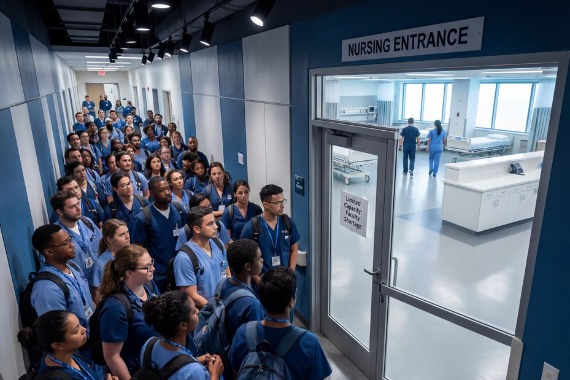
Everyone talks about the nursing shortage. Fewer people talk about why it persists despite growing interest in the profession. The uncomfortable truth is that we could have twice as many people eager to become nurses tomorrow and it wouldn't matter. The system cannot train them. Nursing schools are turning away qualified applicants not because those applicants lack potential, but because there aren't enough faculty to teach them and not enough clinical sites to train them. This is the shortage within the shortage, and until we address it, the broader nursing crisis will only deepen.
For employers watching their requisitions age and their units run short-staffed, this isn't an abstract policy problem. It's a supply constraint that directly affects your ability to hire. For educators navigating impossible workloads, it's a daily reality that rarely gets the attention it deserves. And for healthcare leaders trying to plan for the future, it's the variable that determines whether the nursing pipeline will ever catch up to demand.
This article breaks down why the nursing faculty shortage matters, what's driving it, and what employers and institutions can actually do to help solve it.
The Overlooked Constraint Is Educators
When most people think about the nursing shortage, they focus on recruitment, retention, and compensation for bedside nurses. These are real issues. But they're downstream of a more fundamental problem: we cannot produce enough new nurses to meet demand because the educational infrastructure is maxed out.
According to the Daily Nurse, the nursing faculty shortage is one of the most significant barriers to expanding the nursing pipeline [1]. Nursing programs across the country are operating at or near capacity, not because of physical space or student interest, but because they lack the instructors needed to teach additional students. Accreditation standards mandate specific faculty-to-student ratios, and when those ratios cannot be met, enrollment is capped regardless of how many qualified applicants are waiting.
The constraint isn't just about headcount. It's about the entire ecosystem required to train competent nurses. Classroom instruction must be paired with hands-on clinical experience, and that clinical experience requires preceptors, placements, and partnerships that are increasingly difficult to secure. Hospitals and clinics that might serve as training sites are themselves short-staffed, making it harder to accommodate students without compromising patient care or overwhelming existing employees.
The result is a bottleneck that limits how quickly the profession can grow. Interest in nursing remains strong. Applications to nursing programs are robust in many regions. But the capacity to convert that interest into licensed, practicing nurses is fundamentally constrained by educator availability and clinical access.
This dynamic has real consequences for employers. Every year that nursing programs turn away qualified applicants is another year of limited supply entering the workforce. The nurses who don't get trained in 2025 won't be available to hire in 2027 or 2029. The pipeline problem compounds over time, and the effects are felt most acutely in facilities already struggling to fill open positions.
Proof the Pipeline Is Constrained
The signs of constrained capacity are visible across the healthcare landscape if you know where to look.
Nursing schools routinely report application numbers that far exceed available seats. Qualified candidates with strong academic records and genuine commitment to the profession receive rejection letters not because they failed to meet standards, but because there simply isn't room for them. This pattern has persisted for years and shows no signs of reversing without structural intervention.
According to UrbanMatter, the United States is projected to face a shortage of over one million nurses by the end of this decade [2]. That projection accounts for current training capacity, and it assumes no significant expansion in the number of graduates entering the workforce each year. If nursing programs could accept and train more students, that shortage projection would look different. But they can't, because the faculty and clinical infrastructure doesn't exist to support expansion.
The constraints create a cascading effect. Fewer graduates mean fewer nurses available for hire. Fewer available nurses mean more competition among employers, higher recruitment costs, and greater reliance on expensive agency and travel staff. Units run short-staffed, increasing the burden on existing nurses. Burnout accelerates. Turnover rises. And some of the nurses who leave the bedside might have become the next generation of educators, further tightening the bottleneck.
For patients, the consequences are equally significant. Short-staffed units correlate with longer wait times, reduced quality of care, and poorer outcomes. The nursing shortage isn't just a workforce problem. It's a patient safety problem rooted in a training capacity problem that most discussions overlook.
Employers often assume that the solution is to recruit more aggressively, offer bigger sign-on bonuses, or expand their geographic search. These tactics can help in the short term, but they don't change the fundamental math. There are only so many nurses available to hire, and that number is constrained by how many nurses the educational system can produce. Until training capacity expands, recruitment will remain a zero-sum competition among employers rather than a path to genuine workforce growth.
Why Nurse Educator Roles Are Hard to Fill
If expanding the nursing pipeline depends on having more faculty, why aren't more nurses becoming educators? The answer involves economics, workload, and institutional support, and none of these factors currently favor the teaching path.
Compensation Gaps
The most straightforward barrier is pay. Nurses who remain in clinical practice, especially those willing to work overtime, nights, or weekends, often earn significantly more than their counterparts in academic roles. The Daily Nurse highlights this compensation gap as a central challenge in attracting nurses to faculty positions [1].
For an experienced nurse considering their options, the math is often unfavorable. Taking a faculty position might mean a pay cut of tens of thousands of dollars annually compared to staying at the bedside. That gap is difficult to justify, especially for nurses with families, mortgages, or student loan debt of their own. The financial incentive points away from education, and it has for years.
Workload and Burnout
Faculty positions are not the low-stress alternative to clinical work that some might imagine. Nursing educators juggle classroom instruction, clinical supervision, curriculum development, student advising, committee work, and often research or publishing expectations. The workload can be relentless, with little downtime between semesters.
Many nurse educators report feeling stretched thin, unsupported, and undervalued by their institutions. Burnout among faculty mirrors burnout at the bedside, but with less public attention and fewer resources directed at solutions. When educators leave their roles, they're difficult to replace, and the cycle continues.
Lack of Institutional Support
Academic institutions have not always prioritized the support structures that nurse educators need to succeed. Professional development opportunities may be limited. Administrative burdens may be high. Class sizes may be pushed to the maximum allowable ratio, leaving little room for individualized attention to students or self-care for faculty.
The Daily Nurse notes that creating supportive environments for nurse educators is essential to retention and recruitment [1]. Without that support, even nurses who are genuinely passionate about teaching may find the role unsustainable over the long term.
Credential Requirements
Many faculty positions require a master's degree or doctorate in nursing, credentials that take years to earn and represent significant financial and time investments. Nurses who might be excellent educators are sometimes excluded from consideration because they lack the academic credentials, even if they have decades of clinical expertise. This requirement narrows the pool of potential faculty and creates an additional barrier to entry.
The cumulative effect of these factors is a chronic shortage of nurse educators that shows no sign of resolving on its own. Without deliberate intervention to change the calculus, the faculty shortage will continue to constrain the nursing pipeline indefinitely.
Solutions That Scale Capacity
Addressing the nursing faculty shortage requires action on multiple fronts. No single intervention will solve the problem, but a combination of approaches can meaningfully expand training capacity over time. The Daily Nurse outlines several promising strategies that institutions and policymakers are exploring [1].
Improving Faculty Compensation
The most direct way to attract more nurses to education is to make the financial proposition more competitive. This means increasing base salaries for faculty positions, offering loan forgiveness or tuition support for nurses pursuing advanced degrees, and providing retention bonuses for educators who stay in their roles.
Some states have implemented grant programs to supplement faculty salaries. Some nursing schools have partnered with healthcare systems to share the cost of educator compensation. These models show promise, but they require sustained funding and institutional commitment to scale.
Redesigning Workload
Compensation alone isn't enough if the job remains unsustainable. Institutions need to examine faculty workloads and identify opportunities to reduce administrative burden, right-size teaching loads, and create more manageable expectations around research and service.
Hiring additional support staff, streamlining curriculum approval processes, and protecting time for teaching and student interaction can all contribute to a more sustainable work environment. When educators feel they can succeed without sacrificing their health or personal lives, retention improves.
Building Institutional Support
Nurse educators need mentorship, professional development, and a sense of being valued by their institutions. Faculty residency programs that support the transition from clinical practice to teaching can help new educators build confidence and skills. Communities of practice that connect educators across institutions can reduce isolation and facilitate knowledge sharing.
Institutions that invest in their faculty, not just as workers but as professionals with career trajectories, will have an easier time attracting and retaining talent. Those that treat educators as interchangeable resources will continue to struggle.
Expanding Clinical Placements
The clinical side of the bottleneck requires its own set of solutions. Healthcare facilities that serve as training sites need incentives and support to take on more students. This might include funding for preceptor training, stipends for nurses who supervise students, and dedicated education units that separate teaching responsibilities from regular patient care.
Simulation technology offers another avenue for expanding clinical capacity. High-fidelity simulation labs can replicate a wide range of clinical scenarios, allowing students to practice skills and develop judgment in controlled environments. While simulation cannot fully replace bedside experience, it can supplement it effectively and reduce the pressure on limited placement slots.
Partnerships between nursing programs and healthcare employers can align incentives and create win-win arrangements. Employers who invest in training capacity today are investing in their future workforce. Nursing schools that cultivate strong relationships with clinical partners can offer students better experiences and improve graduate outcomes.
Creating Flexible Pathways to Teaching
Not every nurse who would make an excellent educator wants to pursue a doctorate or commit to a traditional faculty career. Institutions should explore alternative pathways that allow experienced nurses to contribute to education in flexible ways.
Adjunct teaching arrangements, clinical-only instructor roles, and hybrid positions that combine practice and teaching can all expand the pool of educators without requiring every participant to follow the same credential track. The goal is to lower barriers to entry while maintaining educational quality.
What Employers Can Do, Not Just Schools
The nursing faculty shortage is often framed as a problem for nursing schools and academic institutions to solve. But employers have significant leverage and self-interest in addressing it. Hospitals, clinics, long-term care facilities, and health systems can take concrete actions that expand training capacity and strengthen the nursing pipeline that feeds their own recruitment needs.
Fund Preceptor Stipends
Nurses who supervise students during clinical rotations take on additional responsibility without corresponding compensation in most cases. This creates a disincentive for experienced nurses to serve as preceptors, limiting clinical capacity. Employers can change this dynamic by offering stipends, bonuses, or other recognition for nurses who take on precepting duties.
Even modest financial recognition signals that the organization values the preceptor role and considers it part of professional contribution rather than unpaid extra work. When precepting is rewarded, more nurses are willing to participate, and clinical capacity expands.
Partner With Programs for Placements
Healthcare facilities can actively cultivate relationships with nursing programs rather than waiting for schools to request placements. Proactive partnerships might include dedicating specific units or shifts to student rotations, coordinating schedules to maximize placement availability, and working with schools to address logistical barriers.
Employers who become known as excellent clinical partners attract strong students who are more likely to seek employment at those facilities after graduation. The investment in partnership pays off in hiring outcomes.
Co-Develop Curriculum Aligned to Real Roles
Nursing education sometimes lags behind clinical reality. Employers who engage with nursing programs on curriculum development can help ensure that graduates are prepared for the actual demands of contemporary practice. This might involve providing input on emerging technologies, evolving care models, or specialty skills that are increasingly important.
Co-development benefits both parties. Schools produce graduates who are better prepared. Employers hire nurses who require less remedial training and can contribute more quickly.
Offer Flexible Teaching Pathways for Experienced Nurses
Many experienced nurses have teaching potential but no clear pathway to explore it. Employers can create opportunities for these nurses to contribute to education without leaving clinical practice entirely.
Options might include:
- Part-time adjunct teaching arrangements that allow nurses to teach one course per semester while maintaining clinical hours
- Guest lecturer roles that bring working nurses into classrooms to share real-world experience
- Preceptor development programs that formalize the training and recognition of nurses who mentor students
- Tuition support for advanced degrees that encourages nurses interested in education to pursue the credentials they need
By making teaching accessible, employers expand the pool of potential educators and demonstrate commitment to workforce development.
Support Simulation and Training Technology
Simulation labs and training technology can reduce pressure on clinical placement availability. Employers can support these efforts by contributing funding, donating equipment, or partnering with schools to provide access to their own simulation resources.
Some health systems have built dedicated simulation centers that serve both internal training needs and external partnerships with nursing programs. This model creates shared value and positions the employer as a leader in workforce development.
Advocate for Policy Change
Employers have a voice in policy discussions at the state and federal level. Using that voice to advocate for increased funding for nursing education, faculty salary supplements, and clinical placement incentives can help create the conditions for systemic change.
Healthcare industry associations, hospital leadership councils, and direct engagement with legislators all represent opportunities to influence the policy environment. Employers who wait for someone else to solve the training capacity problem may wait indefinitely.
How C3H Global Helps
The nursing faculty shortage won't be solved overnight, but employers can take immediate steps to improve their position. One of those steps is expanding visibility for hard-to-fill roles, including nurse educator jobs that are essential to rebuilding the pipeline.
C3H Global Solutions is a veteran-owned, US-based healthcare job platform that connects employers with qualified candidates across nursing, allied health, and healthcare education roles. If your current job boards aren't reaching the educators, preceptors, and clinical specialists you need, it's time to diversify your sourcing channels.
What C3H Global offers:
- Targeted job listings that reach candidates actively seeking nurse educator jobs, clinical instructor positions, and other roles critical to workforce development
- Healthcare-focused audience that filters out irrelevant applicants and improves the quality of your candidate pipeline
- Recruiter services designed for the unique challenges of healthcare hiring, including hard-to-fill specialty and education roles
- Affordable pricing that works for academic medical centers, community hospitals, and long-term care facilities alike
- Global reach that expands your talent pool beyond local and regional candidates
Building the nursing pipeline requires more than posting on the same boards everyone else uses. It requires reaching candidates where they are and making your opportunities visible to professionals who might otherwise never see them.
Ready to fill your educator and clinical roles? Visit www.c3hglobal.com to post your next position or connect with the team about building a long-term talent pipeline for your organization.
Frequently Asked Questions
What is the nursing faculty shortage?
The nursing faculty shortage refers to the lack of qualified instructors available to teach in nursing programs. This shortage limits how many students nursing schools can accept, which in turn constrains the supply of new nurses entering the workforce each year.
How does the nursing faculty shortage affect the broader nursing shortage?
Nursing programs must maintain specific faculty-to-student ratios to meet accreditation standards. Without enough faculty, schools cannot expand enrollment even when qualified applicants are available. This bottleneck limits the number of new graduates and perpetuates the nursing shortage 2025 and beyond.
Why don't more nurses become educators?
Several factors discourage nurses from pursuing faculty roles. Compensation is often significantly lower than bedside nursing, especially when overtime and shift differentials are considered. Workloads are demanding, with expectations around teaching, advising, research, and service. Many nurses also lack the advanced degrees required for faculty positions, creating an additional barrier.
What nursing shortage solutions address the faculty problem?
Effective solutions include increasing faculty compensation to make teaching more financially attractive, redesigning workloads to reduce burnout, expanding clinical placements through employer partnerships, investing in simulation technology to supplement hands-on training, and creating flexible pathways that allow experienced nurses to teach without committing to traditional academic careers.
How can employers help expand nursing education capacity?
Employers can fund preceptor stipends, partner with nursing programs to provide clinical placements, co-develop curriculum that aligns with real-world practice needs, offer tuition support for nurses pursuing education credentials, and invest in simulation and training technology. These actions expand the infrastructure needed to train more nurses.
References
- Daily Nurse. "Nursing Faculty Shortage Solutions." https://dailynurse.springerpub.com/nurse-educator/nursing-faculty-shortage-solutions/
- UrbanMatter. "America's Nursing Shortage: Causes and Solutions." https://urbanmatter.com/americas-nursing-shortage-causes-and-solutions/