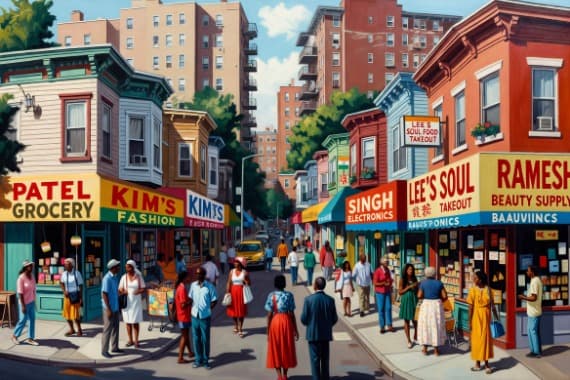
The Rolodex That Builds Wealth
Turning Buy Black From a Moment Into an Institution
A hashtag fades by Friday. An institution compounds for generations. Here is how to build the second one.
By C3H Global Editorial | Published June 16, 2026 | 12 min read
KEY TAKEAWAYS
- A dollar deposited at a Black owned bank reinvests three to four times more in the local community than at a typical bank, according to the National Bankers Association.
- Only 38 percent of Black owned businesses that apply for financing get the full amount, compared with 62 percent of white owned firms.
- Roughly 21 Black owned banks and more than 200 Black owned credit unions remain in the United States, and they grow only when the community deposits in them.
- A verified, repeatable rolodex turns scattered buy Black moments into the steady reinvestment that actually builds wealth.
In 1865, weeks after slavery ended, the federal government chartered the Freedman's Savings Bank so that newly freed people could do something the country had never permitted, which was to keep their own money in their own names. Tens of thousands believed in it. They carried in coins, wages, and the first earnings of their freedom. Nine years later the bank collapsed under mismanagement and fraud at the top, and those savings vanished with it.
The lesson seared into Black financial memory was not that saving is foolish. It was that an institution you do not control can lose everything you trust it with. That memory still sits underneath every buy Black conversation we have today, because it asks the right question. Spending is a movement, and movements fade. What turns spending into wealth is an institution, something owned, repeatable, and trustworthy enough to return to a thousand times. This is a guide to building that, whether you shop or you sell.
We Have Built This Before
The Freedman's Bank collapse was a wound, not a verdict, because the community kept building anyway. In 1903 Maggie L. Walker chartered the St. Luke Penny Savings Bank in Richmond and became the first Black woman to found a bank in the United States, turning a fraternal society's pennies into mortgages and businesses for people the white banks refused to serve. A generation later the Greenwood district of Tulsa, Oklahoma grew into what the nation came to call Black Wall Street, a self contained economy where a dollar moved from a Black grocer to a Black tailor to a Black doctor many times over before it ever left the neighborhood.
Then a white mob burned Greenwood to the ground in 1921, and that is the other half of the truth. Black wealth in America has rarely failed on its own merits. It has been built, then destroyed, then built again. What this article describes is not a new dream. It is the resumption of an old and proven one, this time with tools that the mob and the redline cannot reach so easily.
A Rolodex Beats a Hashtag
A boycott is an event. A trending hashtag is a moment. On their own, neither builds anything, because a dollar that comes home once and leaves the next morning has not changed the underlying math. What changes the math is a habit with a memory, a system that tells you exactly where to send your money every time, so you never slide back to the nearest chain out of pure convenience.
Call it a rolodex. The old hardware is beside the point, the principle is what matters. A working Black business rolodex is an organized, verified list of the people you buy from across the categories you actually spend in, week after week, on purpose. It is the difference between supporting Black enterprise when a tragedy is trending and supporting it on an ordinary Tuesday when no one is watching. The first is a reaction. The second is an economy. And a list you trust closes the exact gap where a fraudulent seller would otherwise slip into your rotation.
The Multiplier You Were Never Told About
Here is a number that belongs on a billboard. According to the National Bankers Association, when you deposit one thousand dollars in a typical bank, roughly one hundred of those dollars get reinvested in your local community. Move that same thousand into a Black owned bank and the figure climbs to somewhere between three and four hundred dollars working close to home. Same money. Three to four times the force on the block where you live.
That is turnover made concrete, and it reframes what a dollar even is. A dollar is not a one time vote you cast and forget. It is a worker, and where you bank decides how many shifts it pulls before it leaves the neighborhood. The same association reports that Black owned banks have grown their small business lending by sixty seven percent over five years, which means those deposits are not sitting still. They are becoming the startup loans and the expansion capital that the wider banking system has long withheld from Black founders. This is the quiet engine of generational wealth. Not one heroic purchase, but a dollar routed through institutions that keep passing it to the next Black hand before it exits.
The Capital Wall Is Still Standing
Now the hard truth, because pretending the field is level serves no one. The barrier that created this entire problem, access to capital, has not fallen. Federal data tells it plainly. A Federal Reserve analysis of Census survey data found that only thirty eight percent of Black owned businesses that applied for financing received the full amount they sought, against sixty two percent of white owned firms. On housing, a 2023 Consumer Financial Protection Bureau report found Black mortgage applicants were turned down at about seventeen percent, more than double the seven percent rate for white applicants.
The institutions built to close that gap are themselves under pressure. Only about twenty one Black owned banks remain in the United States, down from hundreds at their historic peak, and the Urban Institute notes they hold a thin slice of the nation's deposits and suffered higher failure rates than other banks after the last recession, precisely because the communities they serve absorbed the worst of it. The tool is real, and it is underpowered. It needs deposits the way a fire needs air.
Sit with the shape of that loop. The families most in need of fair credit are served by the institutions most starved of capital, a circuit wired generations ago and never rewired. None of it is your personal failing. All of it answers to where you decide to keep your money, which is the one lever this article keeps returning to because it is the one you actually hold.
Verification Is the Keystone, Not the Decoration
A rolodex only builds wealth if every name inside it is real. That is why verification is not a safety feature bolted onto the side of this idea. It is the keystone the whole arch leans on. A directory packed with unverified listings is just a social feed with extra steps, and a feed is exactly where the counterfeits live. The moment a single fake business earns a slot in your weekly rotation, your reinvestment leaks straight back out to the same extraction the entire effort was meant to escape.
So trust has to be engineered in, not wished for. When a platform confirms a real person and a registered business before a listing ever goes live, it gives you back something a hashtag never could. It lets you stop investigating strangers and start investing in your own. Verification is what makes a rolodex worth keeping, and a rolodex is what makes reinvestment a habit instead of a holiday.
How to Build Your Own Black Wealth Rolodex
None of the following is a slogan, and none of it is generic. Each step is a specific action you can take this week, whether you are a shopper, a founder, or both.
- Bank Black with your main account, not just your spare change. Move your direct deposit or your primary savings to one of the country's Black owned banks or to a Black owned credit union, of which there are more than two hundred. Most now offer switch kits that migrate your direct deposits and automatic payments for you, plus shared branching and large surcharge free ATM networks, so you give up almost no convenience. This is the highest leverage move on the list, because it changes how every dollar behaves, not only the ones you spend on purpose.
- Anchor your recurring spend, not your impulse buys. Write down the categories you pay for every single month without fail: groceries, prepared food, hair and beauty, childcare, home services, professional services. For each one, find and lock in a verified Black owned provider you will return to by default. Recurring spending compounds. A one time gift, however heartfelt, does not.
- Verify before you add a name. Before a business earns a permanent slot in your rotation, confirm a real owner and a registered entity, look for a track record rather than a single viral clip, and when you are unsure, source the listing through a directory that verifies for you. Your rolodex is only as strong as its weakest entry.
- Favor businesses that themselves bank and buy Black. The deepest impact comes from finding the nodes that pass the dollar onward rather than out. Ask your barber, your caterer, your contractor where they bank and where they source. When the businesses you support also keep their money in the community, the turnover compounds on itself.
- If you are a founder, get registered and get listed. Legitimacy and visibility are not optional extras. Register the business properly, then claim your place on verified directories where buyers who are actively searching for you can both find you and trust what they find.
- If you are a founder, build the banking relationship before you need the loan. Open accounts with a Black owned bank, a credit union, or a community development financial institution early. These lenders exist specifically to extend capital where the mainstream system says no, and the relationship you build in calm seasons is the one that funds you in a crunch.
The Objection Worth Answering Honestly
There is a real friction here, and it deserves a straight answer rather than a pep talk. Sometimes the verified Black owned option costs a little more, or sits a few miles farther, or has not yet matched the frictionless checkout of a giant. That gap is not a character flaw in the business. It is the direct echo of the capital wall we already walked through, the funding a founder was denied showing up as the slightly higher price you pay at the register.
So treat the small premium for what it is, an investment rather than a tax. The extra few dollars routed to a Black owned business that banks Black and hires Black does more work in your community than the same dollars handed to a chain that exports every cent by closing time. You will not move every purchase, and you do not have to. Shift the recurring ones, the spending you already do on autopilot, and let convenience keep the rest. Progress here is a direction, not a purity test, and a well built rolodex makes that direction the path of least resistance instead of the hard one.
For the Founder, Getting Found Is Half the Battle
A Black owned business rarely fails for lack of talent. It fails for lack of two things the data makes painfully clear: capital and visibility. The capital gap we already named, thirty eight cents of funding on the dollar against sixty two for white owned firms. Visibility is the other blade. A business no one can find, or one drowned beneath a tide of synthetic competitors, starves no matter how good the craft is.
Both have concrete answers. On capital, the community development financial institution and minority depository institution system was built for exactly this founder, offering credit and patient money where the mainstream banks decline. On visibility, a verified directory does what an algorithm will not. It connects a founder who has proven they are real to a buyer who is specifically trying to spend with someone real. That is not advertising. It is matchmaking with a verification layer underneath it, and it is how a small Black owned business stops competing against fakes and starts competing on merit.
Verification also hands the honest founder something the fakes quietly stole, which is the benefit of the doubt. In a market now crowded with synthetic sellers, a confirmed identity and a registered business are no longer mere paperwork. They are a competitive advantage, the signal that lets a cautious buyer finally commit. The founder who can prove they are real inherits the trust the counterfeits burned through, instead of paying for their sins.
The Institution We Build Now
The Freedman's Savings Bank failed because freed people were handed an institution they did not own or control. The century and a half since has been one long argument over who gets to hold the machinery of their own economy. Every tool in this guide, the Black owned bank, the credit union, the community lender, the verified directory, is a piece of that machinery finally being built by and for the community it serves.
A rolodex sounds humble next to a trillion dollars of annual buying power. But that trillion is already ours, and it leaves every day. The rolodex is how it stays. Wealth was never a windfall. It is a dollar made to work again and again inside the same community until the working itself becomes an inheritance. That is the institution worth building now, and unlike 1865, this time the keys are in our own hands.
Frequently Asked Questions
What does it mean to bank Black?
Banking Black means moving your primary checking or savings to a Black owned bank or credit union, where the majority of the board or stockholders are Black Americans. These institutions reinvest deposits into local lending, small businesses, and homeownership at far higher rates than mainstream banks.
How much more does a dollar do at a Black owned bank?
According to the National Bankers Association, one thousand dollars at a typical bank returns about one hundred dollars to the local community, while the same amount at a Black owned bank reinvests roughly three to four hundred dollars locally, three to four times the impact.
How do I find verified Black owned businesses I can trust?
Use a directory that confirms a real owner and a registered business before listing, rather than relying on a profile or a video. Verify a track record over time, and build a repeatable rolodex you return to for your recurring spending.
Why do Black owned businesses struggle to get loans?
Federal data shows only 38 percent of Black owned businesses that apply for financing receive the full amount, compared with 62 percent of white owned firms. Community development financial institutions and minority depository institutions exist to extend capital where mainstream banks decline.
How does a Black business directory build generational wealth?
It turns occasional support into a repeatable habit. A verified directory lets you reinvest in real Black owned businesses every week, raising how many times each dollar circulates locally before it leaves, which is the core mechanic behind lasting community wealth.
Build the rolodex. Keep the dollar home.
Find and list trusted Black owned businesses on ground that verifies every name.
Start with C3H GlobalSources
- National Bankers Association, on local reinvestment rates and Black owned bank small business lending growth
- Federal Reserve small business credit survey, Census data, on business financing approval gaps
- Consumer Financial Protection Bureau, 2023 mortgage market report, on denial rates
- Urban Institute, on the number, deposits, and capital constraints of Black owned banks
- FDIC list of Minority Depository Institutions, on the count of Black owned banks