Owning the Corner Again

How Black neighborhoods became someone else's market, and how we take them back.
C3H Global Editorial | 9 min read | Sourced and Verified
Walk through almost any historically Black neighborhood in America and ask one plain question. Who owns the store you buy from, and where do they sleep at night? For generations the answer has rarely changed. Someone who earns here and lives elsewhere. That gap, between where the money is made and where it goes home, is the quiet engine of a wealth divide that no amount of hard work inside the neighborhood has ever managed to close.
This is not a story about bad neighbors. It is a story about a system that decided, long before any of us were born, who would be allowed to own and who would only ever be allowed to spend.
Built to Fail: How the Vacuum Was Created
The emptiness that outside businesses later filled was manufactured by policy. In the 1930s the federal Home Owners Loan Corporation drew color coded maps of American cities, marking Black neighborhoods in red as hazardous for lending. That practice, now known as redlining, told banks and insurers exactly where not to put money. Capital drained out. Mortgages dried up, storefronts shuttered, and the national retail chains that anchored white commercial districts simply refused to build. What remained was a commercial vacuum sitting inside neighborhoods full of working people who had money to spend and nowhere local to spend it.
The damage was not limited to home loans. Federal housing policy and the insurers that followed its maps treated the same neighborhoods as uninsurable, which meant a would be shop owner could not protect inventory, secure a lease, or qualify for the commercial credit a business needs to open its doors. Where legitimate credit vanished, predatory substitutes rushed in to fill the space. Families who could not get a fair mortgage were funneled into contract buying and high cost lending that stripped wealth rather than building it, a transfer documented in city after city.
The lesson compounded across decades. A neighborhood cannot grow the businesses it is forbidden to finance, and the absence of Black owned stores on Black blocks was never a question of effort or ambition. It was the engineered result of a lending system built to starve those blocks of the one ingredient every business needs to exist, which is capital. Hold that fact close, because it reframes everything that follows.
The Middleman Position
Into that engineered vacuum came immigrant entrepreneurs, many of them Korean across the second half of the twentieth century, who were fleeing a vacuum of their own. Sociologist Edna Bonacich, whose 1973 theory of middleman minorities remains the foundational work on this pattern, described how groups facing discrimination in the broader economy get funneled into a narrow commercial role. Banks denied them loans too, so they pooled capital through family and community. Shut out of corporate jobs their degrees should have unlocked, many had little real choice but to open small shops where rents were low and competition was thin, which meant precisely the neighborhoods redlining had abandoned.
That is the middleman position. One group ends up operating the daily commerce of a community it does not live in, suspended between the powerful interests above it and the customers below it. Bonacich was careful about something most retellings drop entirely. She described the middleman merchant as both oppressed and oppressor at the same time. The owner was squeezed from above by wholesalers and banks, and the owner also drew from below, because profit earned on the block still left the block every night. Scholars who studied the Korean and Black conflicts of the era reached a parallel conclusion. The merchant became the visible face that absorbed a frustration whose true source, the racial and economic inequality engineered by the dominant structure, stayed comfortably out of frame.
So name the exploitation honestly, without firing it at the wrong target. Extraction was real. Dollars did leave. And the person standing at the register was rarely the architect of why.
When the Friction Turned Fatal
The middleman structure did not stay on the ledger. It spilled into the street, again and again, in encounters that ended a child's life over the price of a snack. In 1991 a Los Angeles store owner shot fifteen year old Latasha Harlins in the back of the head during a dispute over a bottle of orange juice the girl had the money in hand to pay for. The court handed the shooter probation and no jail time, and that non punishment, landing beside the Rodney King verdict, helped ignite the 1992 Los Angeles uprising.
More than three decades later the pattern repeated almost line for line. In June 2026 a South Carolina jury acquitted convenience store owner Rick Chow of murder after he chased fourteen year old Cyrus Carmack Belton more than one hundred and thirty yards from his store and shot him in the back, over four bottles of water that surveillance video showed the boy had already returned. Two children, a generation apart, suspected of petty theft, killed by the men who ran the stores in their neighborhoods, with verdicts their communities received as a plain statement about whose life was counted and whose was not. This is the sharpest edge of an arrangement that hands strangers control of a community's daily commerce while leaving the residents with neither ownership above the counter nor protection in front of it.
The Wedge: A Story Built to Keep Us Apart
After World War II the dominant culture supplied exactly that story. It is called the model minority myth, the claim that one minority climbed through pure values while another stayed down through its own failings. Political scientist Claire Jean Kim gave the mechanism its name in 1999, racial triangulation, and her finding is precise. Asians were praised relative to Black Americans not as a favor to Asians but as a weapon against Black demands for justice. As Kim has put it, the entire purpose of these classification systems is to divide and conquer.
The timing was no coincidence. As NPR and a body of academic work have documented, the wedge sharpened during the Civil Rights era, when the image of a quietly succeeding minority was held up to argue that racism could not possibly explain why Black Americans were struggling. If one group could make it, the argument went, the other group's failure had to be its own fault. The corner store owner and the customer were handed roles in a production neither of them wrote. One was cast as living proof the system was fair. The other was cast as proof that the problem was character rather than oppression. Both were being managed, and the friction between them kept the spotlight off the people who profited from the whole arrangement.
The Same Robbery, A New Mask
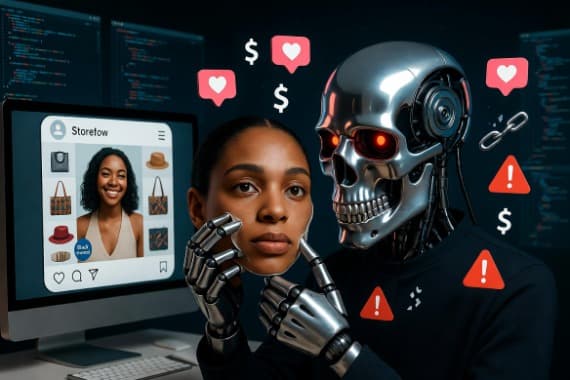
If any of this sounds like buried history, open your feed. The buy Black movement gave Black dollars a clear destination, and fraud moved instantly to intercept them. Reporting from The Verge, citing researchers at Riddance.ai, describes synthetic Black entrepreneurs generated entirely by AI and deployed across TikTok, Instagram, and Facebook at a rate of roughly one hundred new fake accounts every single day. The founder is not real. The tearful story about being doubted is a script. The handmade product was mass produced and dropshipped, and the markup flows to a network that has never set foot in any Black community.
The scale is not fringe. TikTok Shop reported that in the first half of 2025 alone it blocked more than seventy million fraudulent products and removed over seven hundred thousand seller accounts for policy violations. And the harm, as in every earlier chapter, lands twice. It robs the Black shopper who believed they were investing in their own. It also salts the ground for every authentic Black founder, because once buyers learn the faces can be faked, they begin to doubt the real ones too. The same research names that chilling effect directly. The mask is new. The theft is old.
Every claim here traces to a named source: Edna Bonacich's middleman minority theory, Claire Jean Kim's racial triangulation, NPR reporting on the model minority wedge, The Verge and Riddance.ai on AI impersonation networks, TikTok Shop's own safety data, and Selig Center figures on Black buying power. No unsourced statistics. No blame assigned to any community as a group.
Follow the Dollar, Not the Folklore
At this point someone usually reaches for the figure that a dollar lives only six hours in the Black community. Set it down. A fact checking investigation by Howard University, through its Truth Be Told project, traced that number to a self help book that never named a single study, and economists noted that several versions of the claim cite spending by religion, a category the United States government does not even collect. A movement cannot stand on a statistic that collapses under one honest question.
The real numbers are stronger anyway. Black buying power in the United States now exceeds one trillion dollars a year. The problem was never how much the community earns. It is how few times each dollar changes hands inside the community before it exits, a turnover gap framed by research from the University of Georgia Selig Center. Money that recirculates locally builds local wealth on every pass, which is the entire logic behind Black owned banks, community development lenders, and cooperatively held real estate. A dollar that pays a Black barber who banks at a Black owned institution that then lends to a Black contractor has worked three times before it leaves. Money that exits on the first transaction builds someone else's tax base. Fix the turnover and you repair the engine, and you do it with facts no critic can take apart.
Ownership and Proof
Every chapter of this story turns on the same two missing pieces, ownership and proof. Redlining denied the ownership. The middleman structure denied it again and pointed the anger sideways. The AI fraud now attacks the proof, betting that you cannot tell a real Black founder from a fabricated one. The correction, then, is not to shop harder or to nurse a grudge against a neighbor who was also being played. The correction is to put ownership back on the block and to make authenticity something a buyer can confirm in seconds rather than hope for.
That is the specific work C3H Global Solutions was built to do. We give Black founders a credible, searchable home through our jobs and services lanes, and we give Black buyers a verified place to spend, so the businesses that serve a community can finally be owned by it. Verification is not a sticker here. It means confirming a real person and a registered business behind every listing, so a shopper does not have to forensically study a video for a sewing machine that never moves or a face that warps between frames. A platform that stands behind who it lists turns a hashtag into infrastructure, and infrastructure is the one thing on this entire timeline that has ever built wealth that stays. Verification closes the door that fraud keeps trying to walk through. Ownership makes sure the next generation inherits the corner instead of renting it from a stranger.
The block was never meant to belong to a stranger, a script, or a server farm. It is time to own it again.
Own the corner. Verify the source.
Find verified Black owned businesses, or claim your place among them.