Commercial Dock and Door Service: The Trade Behind Every Warehouse
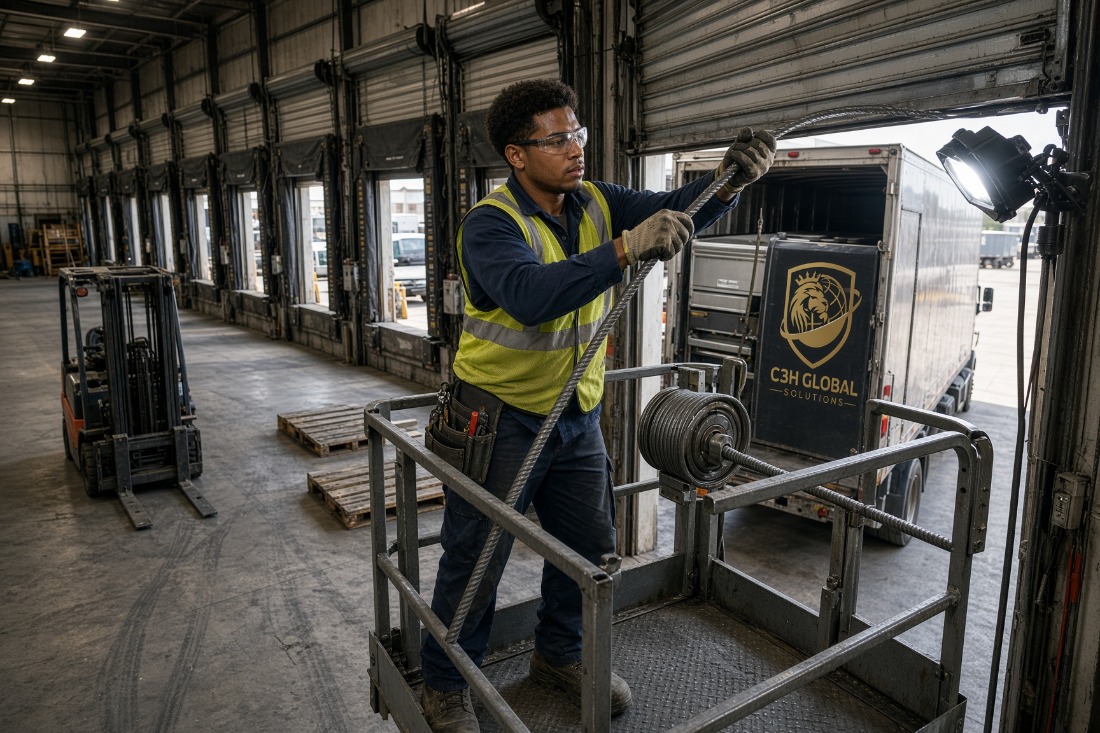
When a loading bay goes down, a warehouse stops loading trucks. Somebody gets paid very well to fix that quickly, and there is no national company doing it.
Commercial dock and door service covers the repair and maintenance of loading dock equipment: dock levelers, roll up doors, dock seals, vehicle restraints and the controls that run them. Revenue comes from emergency repair calls at premium rates and from quarterly preventative maintenance contracts. It's skilled electrical and hydraulic work, and demand tracks warehouse growth.
The keys to this article
- A dead loading bay stops trucks. That's why same day repair commands premium pricing and why nobody haggles.
- OSHA's dockboard standard requires this equipment to be maintained, which puts your service on the compliance side of the ledger rather than the discretionary side.
- Quarterly preventative maintenance contracts turn emergency work into a predictable base.
- BLS projects the broader industrial mechanic occupations to grow 14 percent through 2035, with about 51,900 openings a year and a median wage above sixty thousand.
- It's genuinely skilled and genuinely hazardous. Stored hydraulic and spring energy is the reason lockout and tagout exists.
- There's no national brand in this space. Every metro is covered by small regional firms driving unmarked vans.
What a dead bay actually costs
A distribution center has fourteen dock positions. On a Tuesday morning, number nine won't lift.
The leveler is down, so the truck at that bay can't be unloaded. Its driver sits there on the clock. Behind them the next appointment slides, then the one behind that, and inbound starts backing up into the yard while the receiving team stands around waiting for something to do. Somebody in an office starts doing arithmetic about the day.
Then somebody calls you.
Nobody on that call asks what your hourly rate is. They ask how fast you can get there, and then they say yes to whatever you tell them.
That is the whole reason this trade pays well, and it's why the source video behind this series is right to point out that operators pay premium rates for same day repair. You're not selling a hydraulic cylinder. You're selling the difference between a warehouse that runs today and one that doesn't.
Why nobody has consolidated this
Walk any industrial park and count the loading bays. Every one has a door, a leveler, a seal and a set of controls. All of it gets slammed dozens or hundreds of times a day by forklifts and by trucks that occasionally miss.
Now try to name the company that fixes them. You can't, and neither can anyone else, because there isn't one to name. The source video makes the point well: every metro is served by small regional players, and most people have driven past their unmarked vans a thousand times without ever wondering what they do.
That fragmentation is your opening. It also means the accounts in your area are held by firms that got them by showing up, and they can be lost the same way.
What actually breaks on a loading dock?
Five things sit at every loading bay. Learn what they do, how they fail and what the repair is worth, and you understand this entire business.
The dock leveler
Steel bridge, dropping from the dock floor onto the truck bed. Mechanical, hydraulic or air powered, and it carries loaded forklifts across that gap all day long.
How it fails: hydraulic leaks, worn lip hinges, failed cylinders, bent decks from a truck pulling away early, control faults.
Why it pays: when the leveler is down, the bay is down. No workaround, no temporary fix, nobody improvising with a pallet jack. This is your most urgent call and your best margin, and both of those are true at the same time for a reason.
The roll up or sectional door
Everything that makes the opening close: the door panel itself, plus springs, tracks, rollers, cables and the operator that drives it.
How it fails: impact damage, broken springs, frayed cables, misaligned tracks, dead operators, failed sensors.
Why it pays: a door stuck open in January is a heating bill and a security problem. A door stuck closed is a bay you can't use. Impact damage is constant, because forklifts and trucks hit them regularly and always will.
The dock seal or shelter
Foam or fabric surround closing the gap between the trailer and the building.
How it fails: tearing, compression, weather rot, and damage from trailers backing in at an angle.
Why it pays: least urgent thing on the dock, easiest thing to add to a quote. It's also where the heating bill and the pest problem come from, and every facility manager understands both of those sentences instantly.
The vehicle restraint
A hook or chock system that holds the trailer against the dock so it can't creep away while a forklift is inside it.
How it fails: mechanical wear, hydraulic issues, control and interlock faults, communication lights.
Why it pays: it's a safety device. The moment one is questionable, nobody wants to be the person who deferred the repair.
The controls
One panel ties the leveler, restraint, door and lights together into an interlocked sequence.
How it fails: relays, sensors, wiring, water intrusion, and the aftermath of somebody having previously bypassed something they shouldn't have.
Why it pays: this is where electrical knowledge earns its keep. It's also the part that separates a service company from somebody with a wrench and enthusiasm.
The word in the regulation that matters
OSHA's dockboard standard, 29 CFR 1910.26, sits inside the walking and working surfaces rules, and its definition of a dockboard covers dock levelers.
The standard requires employers to make sure dockboards can support the maximum intended load. For dockboards put into service on or after January 17, 2017, it requires them to be designed, constructed and maintained to prevent transfer vehicles running off the edge. There's an exception where an employer can demonstrate no such hazard exists. Portable dockboards have to be secured against moving out of position.
Notice that word, maintained. The employer's obligation doesn't end at purchase. It continues for as long as the equipment is in service, and the person who keeps it in that condition is you.
It puts your service on the compliance side of a facility manager's budget rather than the nice to have side, and those two budgets get treated very differently when things are tight.
Who buys, and how they think
| Customer | What they run | What they care about | Why they matter |
|---|---|---|---|
| Distribution centers | Dozens of bays, heavy cycles | Uptime and one call resolution | High bay counts and real budgets |
| Third party logistics operators | Multiple sites under one contract | Consistency and reporting across locations | One relationship, many buildings |
| Grocery and food distribution | Refrigerated docks, seals under stress | Temperature integrity and fast response | Equipment works harder, so it fails more |
| Manufacturing plants | Shipping and receiving docks | Not interrupting production | Steady preventative work, less drama |
| Property managers of industrial parks | Many tenants, shared docks | One vendor, clean invoicing | Access to a whole park through one contact |
| Municipal and institutional facilities | Service docks at schools, hospitals, depots | Purchase orders and documentation | Slow to win, contracted, rarely lost |
Notice the pattern. Everybody on that list measures the same thing, which is how long the bay was out of service. Beat the clock consistently and price becomes a secondary conversation.
How does the money actually work?
Two revenue lines, and they feed each other.
Emergency repair. Called in when something breaks, billed at a premium because the customer's alternative is a stopped dock. This is what gets you in the door and it's the highest hourly work you'll do.
Preventative maintenance contracts. Scheduled inspections, usually quarterly, across every bay in the building. The source video describes operators signing these specifically so they don't get caught with a dead bay during their busiest shipping weeks. It illustrates the shape with twenty warehouse accounts on quarterly service at a few hundred dollars a visit, before emergency work. Treat those figures as the structure rather than a quote for your market.
Here's the model in plain form. Contract revenue equals accounts, multiplied by bays per account, multiplied by your per bay inspection rate, multiplied by four visits a year. Then add parts, then add emergency calls, which arrive whether or not you planned for them.
Three numbers make that real, and you can gather them in a week. Drive an industrial park and count bays on three buildings. Call two established firms in a neighboring metro as a prospective customer and ask their quarterly PM rate per position. Then ask a facility manager you can get to what their current response time is.
That last number is the one telling you whether there's room in your market.
Why the contract matters more than the emergency work. Emergency calls are profitable and unpredictable. Contracts are predictable and they generate emergency calls, because a technician who inspects a building quarterly finds problems, gets known, and becomes the number people dial at seven in the morning. Build for the contracts and the emergencies follow.
The skill, and the part where you take it seriously
There's an honest reason the source video ranks this business where it does. It takes electrical and hydraulic knowledge, and it can be dangerous.
That's correct, and it deserves more than a passing mention.
Dock levelers hold hydraulic pressure. Door assemblies hold spring tension that can be measured in hundreds of pounds of stored force. Controls carry live power. Every one of those systems can release energy suddenly if it's serviced by somebody who assumed it was safe because it wasn't moving. This is precisely the hazard that OSHA's control of hazardous energy standard, commonly called lockout and tagout, exists to address, and it's not a formality in this trade.
So the entry path here runs through competence rather than around it, and that's exactly why the work pays.
The encouraging half. The broader trade is short of people and getting shorter. BLS projects employment for industrial machinery mechanics, machinery maintenance workers and millwrights to grow 14 percent from 2025 to 2035, much faster than average. That's about 51,900 openings a year, many of them driven by people retiring or moving on. Median annual pay for those occupations was $64,100 in May 2025, and BLS notes that industrial machinery mechanics typically need a high school diploma plus at least a year of on the job training.
A trade growing at that rate while that many people walk out of it isn't a closed door. It's a door with nobody standing in it.
Three ways in, and only one requires you to already know this
Work for a dock and door company first. The fastest and cheapest education available. A year on somebody else's truck teaches you diagnostics, parts, pricing, customer handling and safety practice at the same time, and the shortage means those companies are hiring.
Buy an existing route or company. Owners in this trade retire like everybody else, and a book of preventative maintenance contracts is a real asset with real value. You inherit the accounts, the reputation and often the technician.
Hire the trade and run the business. Legitimate, and common in every service industry. You handle sales, contracts, dispatch, scheduling and invoicing, and a qualified technician does the work. In a trade this short of people, your job becomes finding and keeping that person, which is a solvable problem with the right approach.
None of those three requires you to be an expert on day one. All three require you to respect the hazard, hire competence and never let commercial pressure push a shortcut on a spring or a cylinder.
How you actually build it
Decide your entry path
Learn it, buy it, or hire it. Everything below assumes you've picked one, because the sequence changes depending on the answer.
Form the entity and get the EIN
An LLC is standard for this trade. The EIN comes free from the IRS in one session. Do it before you buy a vehicle or open supplier accounts.
Open business banking immediately
Commercial customers pay on terms, which means you're financing thirty to sixty days of work at any moment. Clean books are what let you borrow against that if you need to.
Get insured for industrial sites
General liability, commercial auto, and coverage at the levels distribution centers require of vendors before they issue a badge. Warehouses have vendor onboarding processes, and insufficient coverage is where applications stall.
Sort safety before your first paid job
Lockout and tagout procedures, personal protective equipment, and a written practice for working on stored energy systems. Document it. Large customers will ask to see it, and more importantly you'll need it long before they do.
Set up parts supply
Distributor accounts for levelers, door components, springs, seals, cylinders and controls. Your response time promise depends entirely on what's on the truck and what you can get by tomorrow.
Kit the service vehicle properly
Common wear parts, hydraulic fittings and hose, spring and cable stock, electrical components, and the tools for all of it. A first visit that fixes the problem is worth three that diagnose it.
Sell contracts, not repairs
Walk into distribution centers and ask for the facilities or maintenance manager. Offer a free dock survey. Count their bays, note the condition, hand them a written summary, and quote a quarterly program. That survey is your entire sales process, it costs you an afternoon, and almost nobody else is offering one.
Publish a response time and hold it
Four hours, next morning, whatever you can actually deliver. The promise you keep is worth more than the faster promise you break, and in this trade word travels between facility managers quickly.
Document every bay
Building, position number, equipment make and model, serial, service history, parts fitted, dates. That record is your quarterly route, your quoting shortcut, and the thing that makes you impossible to replace.
What separates the firms warehouses keep
They answer at seven in the morning.
Docks break at shift change. The company that picks up before the coffee is made becomes the default call.
They fix it on the first visit.
Two trips for one fault costs the customer another half day. Stock the truck properly and this mostly stops happening.
They report what they found.
A quarterly summary listing what was inspected, what was adjusted and what will need replacing in six months lets a facility manager plan a budget. You just made their job easier, and people renew with the vendors who do that.
They never bypass a safety device.
Somebody will eventually ask you to jump an interlock so a bay can keep running. The answer is no, and explaining why in plain language earns more respect than agreeing ever would.
They leave the dock clean.
Hydraulic fluid on a warehouse floor is a slip hazard with an incident report already half written. Bring absorbent, use it, take the waste with you.
Where does this business lead next?
Growth here comes through portfolios rather than one building at a time.
Your first step up is the third party logistics operator running several sites, where one conversation can add four buildings. Next comes the national account, where a large distributor wants consistent service across a region and starts asking whether you can cover more territory. That's the point where the business becomes a company rather than a truck.
Federal work is a genuine third step, and it usually starts as a subcontract. Government warehouses, depots, commissaries, postal facilities and military installations all run loading docks, and all of that equipment falls under facilities support contracts held by primes. A licensed, insured, properly documented small firm with a service history is exactly what a prime needs when their scope includes dock equipment they have no intention of servicing themselves. Small business participation is frequently a requirement of the award rather than a favor.
Everything that path asks for, you build by running the work well. An entity, an EIN, federal registration, insurance, a safety program and documented past performance. Two years of quarterly service records across a dozen buildings is past performance.
The words you'll hear on the dock
Picking these up early is how you stop sounding new on a facilities call.
- Dock leveler. The powered or mechanical bridge between the dock floor and the trailer bed. OSHA's dockboard definition includes it.
- Dockboard. OSHA's umbrella term covering dock plates, bridge plates and levelers, addressed in 29 CFR 1910.26.
- Vehicle restraint. The device that holds a trailer to the dock so it can't creep away during loading.
- Dock seal or shelter. The surround closing the gap between trailer and building.
- Sectional and roll up doors. The two common commercial door types, each with its own spring, cable and track systems.
- PM contract. A preventative maintenance agreement, usually quarterly, covering scheduled inspection of every dock position.
- Bay or position. One dock opening. The unit you count, quote and bill against.
- Lockout and tagout. The practice of isolating and securing hazardous energy before servicing, addressed by OSHA's control of hazardous energy standard.
- Interlock. The control logic linking restraint, leveler and door so they operate in a safe sequence.
Where C3H Global fits
This business lives or dies on contracts, and contracts are our trade.
C3H Global Solutions is a veteran owned management consulting and program support firm. Service agreements, scope definition, response commitments and reporting structures are the work we do for clients. They're also exactly what turns dock and door work from a run of emergency calls into a company with predictable revenue.
We help with the parts that decide whether a preventative maintenance program is profitable or painful. What the agreement covers and what it excludes. How response times are defined so you can meet them. What the quarterly report contains so a facility manager renews without a conversation. How parts and labor are priced inside a contract rather than bolted onto it afterward. Get those right at your first agreement and every one after it is a copy. Get them wrong and you'll spend three years discovering it one dispute at a time.
We also handle the setup underneath. Entity structure, EIN and registration sequencing, banking, the insurance profile that gets you through a distribution center's vendor onboarding, and the records structure that supports institutional and federal work later.
And when you need a technician, you're hiring in a trade BLS says is short thousands of people a year. Post the role where industrial maintenance, millwright, HVAC and facilities people are actually looking.
Because we work as both a prime and a subcontractor across facilities support and logistics, well documented service firms make natural teaming partners when a federal facilities contract includes dock equipment.
Start at https://www.c3hglobal.com/ and choose Recruiter to hire, Service Provider to list your firm, or C3H Explorer to look around. For contract structure, setup or teaming, email help@c3hglobal.com.
Frequently asked questions
What does a dock and door service company actually do?
Repairs and maintains loading dock equipment, meaning dock levelers, roll up and sectional doors, dock seals and shelters, vehicle restraints and the control systems tying them together. The work splits between emergency repair calls and scheduled preventative maintenance.
How much does it cost to start a dock and door repair business?
The main costs are a properly equipped service vehicle, tools, an opening parts inventory, insurance at commercial vendor levels, and either training time or a technician's wages. Buying an existing route with contracts already in place is a common alternative entry.
How much can you make in dock and door service?
Revenue comes from emergency repair at premium rates plus quarterly maintenance contracts billed per dock position. Because contract revenue scales with bay counts rather than customer counts, a handful of large distribution centers can outperform dozens of small accounts. BLS reports median pay of $64,100 in May 2025 for the related industrial mechanic occupations, though that describes employees rather than owners.
Do you need a license to repair loading dock equipment?
There's no single national license for this trade, but state and local business licensing applies, electrical work may require a licensed electrician depending on scope and jurisdiction, and commercial customers will require insurance and often safety documentation before allowing you on site. Confirm the rules for your state and the scope you intend to take on.
Is dock and door repair dangerous?
It carries real hazards. Hydraulic systems hold pressure and door assemblies hold significant spring tension, both of which can release suddenly during servicing. OSHA's control of hazardous energy standard, known as lockout and tagout, addresses exactly this class of risk. Proper training and procedures are not optional in this trade.
Can a dock and door company get government contracts?
Yes, usually as a subcontractor to a prime holding a facilities support or base operations contract. Government warehouses, depots and installations all operate loading docks. You'll need an entity, an EIN, federal registration, insurance and documented past performance.
Sources
- OSHA, 29 CFR 1910.26 Dockboards: https://www.osha.gov/laws-regs/regulations/standardnumber/1910/1910.26
- U.S. Bureau of Labor Statistics, Occupational Outlook Handbook, Industrial Machinery Mechanics, Machinery Maintenance Workers, and Millwrights: https://www.bls.gov/ooh/installation-maintenance-and-repair/industrial-machinery-mechanics-and-maintenance-workers-and-millwrights.htm
Licensing, insurance and safety requirements vary by state and locality and do change, so confirm the specifics for your area and your intended scope with the relevant agencies. This article is educational and is not legal, tax, financial or regulatory advice.
Spend an afternoon in an industrial park.
Drive one. Count the dock positions on three buildings and you'll have a sense of the equipment sitting in your market. Then ask a facility manager how long it takes to get a leveler fixed. If the answer is longer than a day, that's your business plan.
When you're ready to build it, the contract work is where we're useful. Agreements that define scope and response properly, reporting that gets renewed without a discussion, pricing that holds up, and the setup underneath it all. Email help@c3hglobal.com and tell us where you're starting.
When you need a technician, hire at https://www.c3hglobal.com/ by choosing Recruiter, or list your firm by choosing Service Provider.
There's no national brand in this trade and there probably never will be. Every metro belongs to whoever answers the phone at seven in the morning and turns up when they said they would.