Is That Interview Question Illegal? Ask Why They Want to Know

Federal law bans fewer interview questions outright than most people think. Disability questions are off limits before a job offer, and requests for genetic information are off limits almost entirely. Questions about religion, family, age, or national origin are usually not illegal to ask, but they can become evidence of discrimination when they shape who gets hired.
Start Here
- "Is that illegal?" is often the wrong question. "Why do they want to know?" is the useful one.
- Before an offer, employers can't ask about disabilities, sick days, or your family's medical history.
- Questions about kids, religion, age, and where you're from are risky for employers and can become evidence of bias.
- You can answer the concern behind a question without handing over the personal details.
- Write down any question that crosses the line the same day: who asked, when, and who else heard it.
- Discrimination charges have deadlines, often 180 or 300 days, so don't wait too long to get advice.
The question landed, and you had about three seconds to decide. Answer honestly and maybe give them a reason to pass on you. Refuse and maybe look difficult. Whatever you chose, you probably replayed it on the drive home, trying to figure out whether you were wronged or just being sensitive.
That second guessing is the part nobody warns you about. When you don't know the rules, you start doubting your own judgment. This guide fixes that. It answers the ten interview questions people ask about most, tells you which ones employers truly can't ask, and hands you a calm reply for the next time one lands.
Is it illegal for an employer to ask that question?
Sometimes, but less often than you'd expect. An employment attorney who covered this topic in a recent video put it plainly: whenever someone asks her whether a question is illegal, her real answer is to ask why the employer wanted to know. A question about your children, your church, or your birthday usually isn't banned by federal law on its own. The trouble starts when the answer affects the decision, or when only certain people get asked.
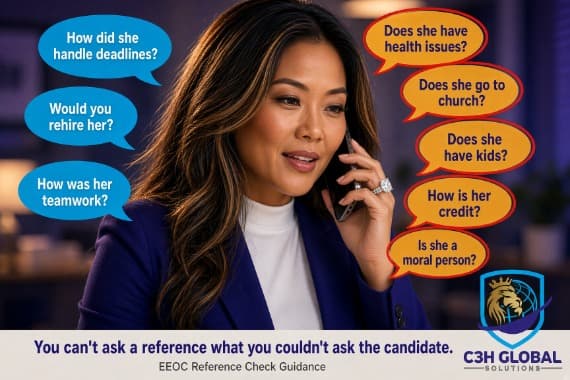
The EEOC frames it the same way. Its guidance says questions asked before hiring should be limited to what's essential for deciding whether someone is qualified, and that other questions may be used as evidence of an intent to discriminate unless the employer can justify them. Two categories go further. Disability related questions are restricted outright before a job offer, and requests for genetic information are restricted almost entirely.
So for each question below, you'll see one of three labels. Off limits means federal law restricts the question itself before an offer. Risky means asking it can become evidence of bias. Usually fine means it's about the job, even if it feels personal.
Which interview questions can employers not ask?
"Do you have any health conditions or disabilities?"
Before a conditional job offer, the Americans with Disabilities Act bars employers from asking disability related questions or requiring medical exams. What they can ask is whether you can perform the functions of the job, with or without a reasonable accommodation. After an offer, medical questions become allowed if every new hire in the same job category is asked the same thing.
Try saying: "I'm confident I can handle every duty in the job description. Which tasks would you like me to walk you through?"
"How many sick days did you take at your last job?"
EEOC guidance singles this one out. Before an offer, employers may not ask how many days you were sick, because the answer is likely to reveal a disability. They can, however, ask about attendance in general and whether you met your last employer's expectations. Your actual sick days stay between you and your old HR department.
Try saying: "I met the attendance standards at my last job, and I'm happy to have my references speak to my reliability."
"Do you have kids, or are you planning to?"
Children, childcare arrangements, marital status, and pregnancy all appear on the EEOC's list of topics that may show an intent to discriminate. Asking only women is treated as clearly discriminatory, and the agency warns that asking everyone can still signal bias, such as against mothers. Once an offer has been made and accepted, some of these questions can come up for legitimate reasons, like enrolling family members in insurance.
Try saying: "If you're asking whether I can work the posted schedule, I can. What hours does the team usually keep?"
"Where do you go to church?" or "Can you work on your Sabbath?"
Title VII protects against religious discrimination. The EEOC advises employers other than religious organizations to avoid questions about religious affiliation, places of worship, or days of worship. An employer can tell you the schedule and ask whether you can meet it. If your faith conflicts with a shift, that's a request for a religious accommodation, which is a separate conversation with its own legal standard.
Try saying: "My faith is personal, but I'm glad to talk about the schedule. Which days would this role require?"
"What year did you graduate?" or "When do you plan to retire?"
Here's a surprise for most people: the Age Discrimination in Employment Act doesn't specifically prohibit asking your age or date of birth. The EEOC has noted, though, that it closely reviews requests for age information because they can enable age discrimination. Graduation years and retirement plans are often stand ins for the same question, which is why they make careful employers nervous. Besides, your graduation year says far more about your playlist than your skills.
Try saying: "I'm focused on where I can contribute over the next several years. What does growth look like in this role?"
"Where are you from? I noticed your accent."
Title VII prohibits discrimination based on national origin. An employer can ask whether you're legally authorized to work in the United States and whether you'll need visa sponsorship. Questions about your birthplace, your ancestry, or your accent are a different matter, and they can become evidence of national origin bias if they influence the decision.
Try saying: "I'm authorized to work in the U.S. and don't need sponsorship. Would you like to hear about my most relevant experience?"
"Have you ever been arrested?"
Federal guidance on criminal records is direct: an arrest alone doesn't prove anyone did anything, and that rejecting someone based on an arrest by itself is not job related. Convictions are treated differently, and employers are expected to weigh the nature of the offense, how much time has passed, and the nature of the job. Many states and cities also have "ban the box" laws that limit when these questions can be asked.
Try saying: "I'm happy to discuss anything relevant to this role once we get to the background check stage."
"What did you make at your last job?"
Federal law doesn't ban this question, but a number of states and cities do, largely because basing new pay on old pay can carry past pay gaps forward. Whether it's allowed depends on where the job is located, so check your state labor department's website before the interview.
Try saying: "I'm targeting a range that reflects this role's responsibilities. What range has the company set for the position?"
"Does anything run in your family, like heart disease or cancer?"
The Genetic Information Nondiscrimination Act generally prohibits employers from requesting genetic information, and family medical history counts. The exceptions are narrow, such as information learned by accident or needed for certain leave certifications, and none of them covers a job interview. Your grandmother's cholesterol is not a qualification.
Try saying: "I'd rather keep my family's health private. Is there something about the job's physical demands I can answer for you?"
"We'd like to run your credit. Is that okay?"
Federal law doesn't stop employers from considering financial information, but the EEOC says those requirements can't be applied unequally or used when they screen out protected groups without accurately predicting who will be reliable. If a screening company runs the report, the Fair Credit Reporting Act requires the employer to tell you in a standalone written notice and get your written permission first. Several states and cities limit credit checks further.
Try saying: "Can you tell me how the credit report relates to this role, and send me the written authorization form?"
| Category | Examples | What it means for you |
|---|---|---|
| Off limits before an offer | Disabilities, health conditions, sick days, family medical history | Federal law restricts the question itself, not just how the answer is used |
| Risky for employers | Children, pregnancy, marriage, religion, age, birthplace, arrests, salary history in some states | Often not banned outright, but can become evidence of discrimination |
| Usually fine | Can you work this schedule? Are you authorized to work in the U.S.? Can you perform these duties? How was your attendance? | About the job, so expect them and answer them |
| Fine with rules | Credit checks and background reports | Require written notice and your written permission when a screening company is involved |
How do you answer an inappropriate interview question?
Most people think there are only two choices: spill everything, or refuse and risk looking difficult. In practice, there are three moves, and the first one works in most rooms.
Answer the concern
Most nosy questions hide a fair worry about schedules, reliability, or commitment. Answer that worry instead of the question.
"If you're asking whether I can travel twice a month, yes, I can."
Redirect to the job
Acknowledge the question lightly and steer back to your qualifications, the way a good reference would.
"I'd love to tell you how I handled a similar project last year."
Decline gracefully
Use this when the question is plainly off limits. Keep it warm, brief, and free of accusation.
"I keep that part of my life separate from work, but ask me anything about the role."
One more tool for your kit: you can ask the question back, politely. "Can you help me understand how that relates to the role?" often reveals the real concern, and sometimes the interviewer realizes mid sentence that they shouldn't have asked.
A five minute prep drill: before your next interview, pick the two questions from this list you'd least like to hear, choose which of the three moves you'll use for each, and say your answer out loud twice. A reply you've rehearsed sounds calm instead of defensive.
A tip on tone: smile, stay brief, and move on. Your goal during the interview is to keep your options open, not to win an argument. You can decide later, with a clear head, whether the question was worth pursuing.
If you're a hiring manager reading this, we wrote a companion guide for you: reference check questions employers can and can't ask, including a ten question script that keeps every call about the work.
The right employer will ask about your work, not your weekends.
Browse open roles on the C3H Global job board, including remote positions. When you find one worth applying for, choose Sign up and select the C3H Explorer role to explore jobs and services in one place.
What should you do after an interview question crosses the line?
An awkward question doesn't automatically mean discrimination happened, and the attorney in the video is clear about that. Her point is that discrimination cases are rarely built on one dramatic statement. They're built on small pieces: an unnecessary question, different treatment for different candidates, and timing. Your notes are those pieces. Write them down the same day, while your memory is sharp.
- The exact question, word for word, as best you remember it.
- Who asked it, their title, and whether they make hiring decisions.
- The date, time, and format, whether by phone, video, or in person.
- Who else was there or could have heard it.
- How you answered, including anything personal you shared.
- What happened next, such as a rejection, silence, or a sudden change in tone, and when.
- Email the notes to yourself. The timestamp shows you wrote them right after the interview, not months later.
Keep these notes somewhere personal, like your own email or phone, not a work device. If the outcome makes you suspect bias, the clock matters. A charge of discrimination generally has to be filed with the EEOC within 180 days, a window that extends to 300 days in places where a state or local agency enforces a similar law. An employment attorney can help you weigh whether it's worth pursuing, and some offer a free first consultation.
Who and what does this article cover?
- EEOC: The U.S. Equal Employment Opportunity Commission, which enforces federal workplace discrimination laws and accepts discrimination charges.
- Americans with Disabilities Act (ADA): The law restricting disability related questions and medical exams before a conditional job offer.
- Title VII of the Civil Rights Act: The law prohibiting job discrimination based on race, color, religion, sex, and national origin.
- Age Discrimination in Employment Act (ADEA): The law protecting workers 40 and older from age discrimination.
- Genetic Information Nondiscrimination Act (GINA): The law barring employers from requesting genetic information, including family medical history.
- Fair Credit Reporting Act (FCRA): The law requiring notice and written permission before an employer obtains a background or credit report from a screening company.
- Conditional job offer: An offer made before final checks, after which certain medical questions may be asked of everyone in the same job category.
- Ban the box: State and local laws that limit when employers can ask about criminal history.
Questions job seekers ask about interview questions
What questions are illegal to ask in a job interview?
Before a job offer, federal law restricts questions about disabilities and health conditions, and employers may not request genetic information such as family medical history. Many other personal questions, about children, religion, or age, aren't banned outright but can become evidence of discrimination.
Can an employer ask if I have kids?
Federal law doesn't ban the question outright, but the EEOC treats questions about children and childcare as possible evidence of intent to discriminate, and asking only women is clearly discriminatory. An employer can ask whether you can work the required schedule.
Can an employer ask how old I am?
The ADEA doesn't specifically prohibit asking your age or date of birth, but the EEOC closely reviews such questions because they can enable age discrimination against workers 40 and older.
Do I have to answer an inappropriate interview question?
No. You can answer the concern behind the question, redirect to your qualifications, or politely decline. Whatever you choose, write down the question, who asked it, and when.
How long do I have to file a hiring discrimination complaint?
Generally 180 days from the discriminatory act to file a charge with the EEOC, or 300 days where a state or local agency enforces a similar law. Talk with an employment attorney early so you don't miss the deadline.
Where can I find jobs from employers that focus on the work?
Browse current openings on the C3H Global job board, then choose Sign up and select the C3H Explorer role to explore jobs and services in one place.
Next time a question lands wrong, you won't need to guess. You'll know whether it crossed a line, and you'll have the words ready.
P.S. Your next interview might be one click away. Browse open roles on C3H Global, and if you'd like more practical career guidance, explore our Guides and Resources library.
This article is general information, not legal advice. Federal discrimination laws generally apply to employers with 15 or more employees (20 or more for age discrimination), and many state and local laws cover smaller employers and add protections, including limits on salary history, criminal history, and credit questions. The attorney's commentary is described as her perspective. For your specific situation, speak with an employment attorney licensed in your state.
Sources
- U.S. Equal Employment Opportunity Commission, "Enforcement Guidance: Preemployment Disability Related Questions and Medical Examinations." eeoc.gov
- U.S. Equal Employment Opportunity Commission, "Prohibited Employment Policies and Practices." eeoc.gov
- U.S. Equal Employment Opportunity Commission, "Pre-Employment Inquiries and Marital Status or Number of Children." eeoc.gov
- U.S. Equal Employment Opportunity Commission, "Pre-Employment Inquiries and Religious Affiliation or Beliefs." eeoc.gov
- U.S. Equal Employment Opportunity Commission, "Pre-Employment Inquiries and Financial Information." eeoc.gov
- U.S. Equal Employment Opportunity Commission, informal discussion letter on age inquiries under the ADEA. eeoc.gov
- U.S. Equal Employment Opportunity Commission, "Fact Sheet: Genetic Information Nondiscrimination Act." eeoc.gov
- U.S. Equal Employment Opportunity Commission, "Enforcement Guidance on the Consideration of Arrest and Conviction Records in Employment Decisions," April 25, 2012. eeoc.gov
- U.S. Equal Employment Opportunity Commission, "Time Limits For Filing A Charge." eeoc.gov
- Federal Trade Commission, "Using Consumer Reports: What Employers Need to Know." ftc.gov
- Employment attorney commentary, "These Job Interview Questions Could Get Employers in Trouble," YouTube. youtube.com