The Reference Check Call That Turns Into Exhibit A
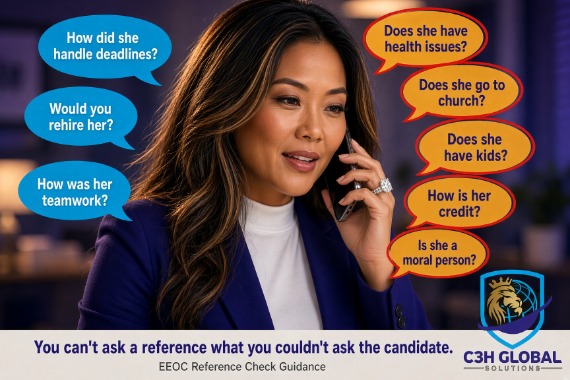
Employers should ask references only job related questions: the candidate's role, responsibilities, quality of work, reliability, attendance against the job's standards, teamwork, policy compliance, and whether they would rehire. Under EEOC guidance, you cannot ask a reference anything you could not legally ask the candidate directly.
The interviews went well, and the candidate is nearly hired. Someone on the hiring team picks up the phone to check one last reference, and the call starts to wander. Does she have any health problems? Is she disabled? Does she go to church? Does she have family obligations? How is her credit? Is she a moral person? At that point, the only thing left to ask is her blood type.
The reference herself described that call in a Reddit post, and an employment attorney walked through it in a recent video. The post can't be independently verified, but every question in it is one employers really do ask. The reference handled it well. She kept bringing the conversation back to one answer:
"I can tell you about the quality of her work."
Here is the part most employers miss. You need to know whether a new hire will show up, do the work, and tell the truth, and references are often your best chance to find out. So when a caller goes off script, it rarely feels like a legal risk. It feels like being thorough. Yet a single unscripted call can become the most useful piece of evidence in a discrimination claim, especially if the candidate doesn't get the job.
This guide sets each risky question beside the question you should ask instead, gives you a ten question script you can use on your next call, and shows you how to keep every reference check consistent.
Which reference check questions create legal risk?
The two question test: Could I ask the candidate this to their face? Would I ask it of every candidate for this role? If either answer is no, cut the question.
Each pair below starts with a question from that call, explains why it causes trouble, and offers a better question that gets you the information you were really after.
Under the Americans with Disabilities Act, employers may not ask disability related questions before making a conditional job offer. EEOC guidance says that also covers questions asked of former employers and other third parties.
You may ask whether someone can perform the functions of the job. Ask about the work itself, never about a condition.
EEOC guidance specifically says that before an offer, employers may not ask how many days an applicant was sick, because the answer is likely to reveal a disability.
Questions about attendance and whether someone met attendance expectations are permitted. The difference is asking about attendance, not illness.
Title VII prohibits religious discrimination, and EEOC guidance is specific here: employers other than religious organizations should avoid asking about religious affiliation, places of worship, or days of worship.
State the schedule and ask about reliability. If someone later needs a religious accommodation, that becomes a separate conversation with its own legal standard.
According to the EEOC, childcare arrangements, children, and marital status belong among the inquiries that can be read as evidence of intent to discriminate, and asking only women crosses into clear discrimination.
You need to know whether someone can meet the schedule. How they arrange their family life to do it is not your business.
A reference is not a credit report. If you get credit information through a background screening company, the Fair Credit Reporting Act requires written disclosure and written permission first, and some states and cities limit credit checks further.
If financial trust truly matters for the role, ask about observed conduct. Run any credit check through a compliant process instead of a phone call.
Ask ten people what makes someone moral and you'll get eleven answers, most of them about things that happen far from the office. A question that vague invites exactly the personal detail you shouldn't be collecting.
Integrity at work is measurable. Ask about honesty, policy compliance, and how she handled mistakes.
| Avoid asking | Why it creates risk | Ask this instead |
|---|---|---|
| Does she have health problems or a disability? | ADA bars disability questions before a conditional offer, including to third parties | Did you see her handle [specific task]? |
| How many sick days did she take? | EEOC guidance says it is likely to reveal a disability | How did attendance compare with what the role required? |
| Does she go to church? | Title VII protects religion; the EEOC advises against affiliation questions | Did she keep the schedules she committed to? |
| Does she have kids or family obligations? | The EEOC treats these as possible evidence of sex discrimination | Was she dependable about agreed hours and deadlines? |
| Does she have bad credit? | Credit reports from screening firms require FCRA notice and consent | Did she follow procedures with money or sensitive data? |
| Is she a moral person? | Too vague, and it invites personal information | Was she honest? Did she follow company policies? |
Does asking a reference instead of the candidate make it safer?
No. The EEOC's guidance on disability questions before a job offer says an employer may not ask a third party any question it could not ask the applicant directly, and it names former employers among those third parties. The same logic applies to religion, family, and the other topics above. Routing a question through a former boss changes who answers it. It doesn't change what your company now knows.
And what you know is the problem. In the video, the attorney explains that when she investigates a hiring decision, she wants to know who asked the question, why they asked it, who heard the answer, and whether that information reached the person who made the final call. Most discrimination cases, she points out, are not built on one obvious statement. They are built on small pieces, such as an unnecessary question, a different standard for one candidate, and the timing of a rejection.
What to do when a reference volunteers personal information
It happens, even on a well run call. Keep a redirect line ready, such as "Thanks, I only need to hear about her work. Can you tell me how she handled deadlines?" Then move on without follow up questions, keep the personal detail out of your notes and away from the person making the decision, and base your evaluation only on what you asked. Make that your standard practice before the first call, not a judgment made in the moment.
What should employers ask on a reference check?
Use the same ten questions for everyone you consider for the role. Each one sticks to work the reference actually saw. Replace [Name] before you dial, and fill in the bracketed task with something specific to your opening.
The C3H Reference Check Script
Open with: "Thanks for making time. I'm calling about [Name], who has applied for our [role] position. I have about ten minutes of questions, all about the work you saw firsthand."
- How do you know [Name], and how long did you work together?Confirms the reference saw the work firsthand.
- What were [Name]'s main responsibilities?
- How would you describe the quality of [Name]'s work? Can you walk me through an example?
- How were deadlines and competing priorities handled?
- How did attendance compare with what the role required?Ask about attendance against the standard, never about illness.
- What was it like for coworkers, customers, or other teams to work with [Name]?
- When feedback or correction came, how was it received?
- Were company policies and procedures followed? Was [Name] honest with you?
- Our role requires [specific skill or task]. Did you see [Name] do that kind of work?
- Would you hire or work with [Name] again? Why or why not?
A perfect reference script is wasted on an empty shortlist. Post your opening on C3H Global and reach job seekers already looking for their next role.
See Recruiter plansTo post, choose Sign up on C3H Global and select the Recruiter role, then add your opening with the schedule and requirements spelled out, so candidates can tell you up front whether they can meet them.
How do you get useful answers when references won't say much?
Some employers will only confirm dates and titles, and some references worry that anything they say could come back to bite them. You can still get useful information without drifting into personal territory.
- Ask for examples, not ratings. "Tell me about a project she handled" produces more than "Was she good?"
- Ask about observable behavior. Deadlines met, mistakes fixed, and feedback handled are things a reference can describe without speculating.
- Lean on the rehire question. A long pause or a carefully worded answer to "Would you work with her again?" often tells you more than a full description.
- Call the references the candidate chose. They tend to be the most willing to talk, and the applicant can prepare them to speak about relevant work.
- Book the call instead of ambushing it. Send a short email first with the job title and a few duties, then schedule ten minutes. A reference who has had time to think gives examples instead of adjectives.
- Listen for what's missing. Faint praise, long pauses, and answers that only cover the easy questions are information too. Ask one gentle follow up, then let the silence do its work.
- Respect "dates only" policies. If a former employer won't go further, thank them and move on. Pushing past that line is how calls end up in personal territory.
- Ask permission before calling a current employer. EEOC guidance notes that an applicant may ask that a current employer not be contacted until after a conditional offer.
Why does consistency matter as much as the questions?
Even good questions create risk when they are asked unevenly. The attorney in the video puts it simply: if one candidate's reference gets a five minute check and another candidate's reference gets a thirty minute interrogation about health, religion, and family, she wants to know why. The EEOC draws the same line on family questions: put them only to women, and the agency treats that as clearly discriminatory.
Consistency comes down to three habits:
- One script for everyone. Every candidate for the same role gets the same questions.
- One trained caller, or a trained few. The people making reference calls should know which topics are off limits and how to redirect.
- One record for every call. Write down what was asked and what was said, using the same sheet each time.
Reference Call Record
What if a background company makes the calls for you?
Outsourcing reference checks doesn't take you outside the rules. The Federal Trade Commission explains that a background check from a third party company is a consumer report under the Fair Credit Reporting Act. When that report is based on personal interviews about someone's character, reputation, or lifestyle, it is an investigative consumer report with additional notice requirements.
If you use a screening company for any consumer report, the FTC describes four basic steps:
- Disclose it in writing. Tell the candidate in a standalone document, separate from the application, that you may use a report.
- Get written permission. The candidate must authorize the report before you obtain it.
- Give notice before rejecting. Provide a copy of the report and a summary of the person's rights before taking adverse action based on it.
- Send the adverse action notice. Include the screening company's contact information and the candidate's right to dispute inaccurate information.
Credit checks follow the same process. The EEOC adds that financial requirements cannot be applied differently by race, sex, or other protected traits, and cannot be used if they screen out a protected group without accurately identifying reliable employees.
Who and what does this article cover?
- EEOCThe U.S. Equal Employment Opportunity Commission, which enforces federal laws against employment discrimination.
- Americans with Disabilities Act (ADA)The federal law restricting disability related questions and medical exams before a conditional job offer.
- Title VII of the Civil Rights ActThe federal law prohibiting employment discrimination based on race, color, religion, sex, and national origin.
- Conditional job offerAn offer made before certain final checks, after which some inquiries become permissible.
- Fair Credit Reporting Act (FCRA)The federal law, enforced by the FTC, governing background and credit reports obtained through screening companies.
- Investigative consumer reportA background report based on interviews about a person's character, reputation, or lifestyle, which carries extra notice requirements.
- Reasonable accommodationA change in how work is done that allows a qualified person with a disability, or a sincere religious practice, to do the job.
- Reference checkA conversation with someone who worked with a job seeker, used to confirm experience and job performance.
Questions employers ask about reference checks
Can an employer ask a reference about a candidate's health?
Not before a conditional job offer. EEOC guidance says an employer may not ask a third party, including a former employer, any disability related question it could not ask the applicant directly. You may ask whether the applicant performed the specific functions of the job.
Can you ask a reference about a candidate's religion or church attendance?
The EEOC says employers other than religious organizations should avoid questions about religious affiliation, places of worship, or days of worship. State the job's schedule instead and ask whether the candidate reliably met schedules.
Can you ask a reference whether a candidate has children?
You should avoid it. The EEOC lists children, childcare arrangements, and marital status among inquiries that may be treated as evidence of intent to discriminate, and asking only women about them is clearly discriminatory.
Can an employer run a credit check during hiring?
Federal law allows it in some circumstances. If a screening company provides the report, the Fair Credit Reporting Act requires written disclosure and authorization first, plus specific notices before and after turning someone down. Several states and cities add further limits.
What is the most useful question to ask a reference?
"Would you hire or work with this candidate again?" It is job related, easy for a cautious reference to answer, and the tone of the answer often reveals more than any rating.
Where can I post a job and find qualified candidates?
You can post openings on C3H Global by choosing Sign up and selecting the Recruiter role. Compare Recruiter plan options on our pricing page, and see the kinds of roles already listed on the C3H Global job board.
Read This Part If Nothing Else
- If you can't ask the candidate, you can't ask the reference.
- Ask about the work: performance, deadlines, attendance against the standard, teamwork, and honesty.
- Never ask about health, sick days, religion, children, or vague "morals."
- Use one script, one trained caller, and one record for every candidate.
- Screening companies and credit checks bring Fair Credit Reporting Act notice steps.
- When a reference volunteers personal details, redirect and keep them out of the decision.
Your next hire starts with the right candidates, so choose a Recruiter plan and post your opening on C3H Global today.
For more practical hiring and career guidance, explore our Guides and Resources library, including our look at whether companies share do not hire lists.
This article is general information, not legal advice. The ADA and Title VII generally apply to employers with 15 or more employees, but many state and local laws cover smaller employers and add protections, including limits on credit checks and caregiver discrimination. The EEOC's preemployment disability guidance was issued in 1995, before the 2008 amendments broadened the definition of disability. The Reddit account and the attorney's commentary are described as reported and reflect her perspective. Talk with an employment attorney about your specific hiring process.
Sources
- U.S. Equal Employment Opportunity Commission, "Enforcement Guidance: Preemployment Disability Related Questions and Medical Examinations." eeoc.gov
- U.S. Equal Employment Opportunity Commission, "Prohibited Employment Policies and Practices." eeoc.gov
- U.S. Equal Employment Opportunity Commission, "Pre-Employment Inquiries and Religious Affiliation or Beliefs." eeoc.gov
- U.S. Equal Employment Opportunity Commission, "Pre-Employment Inquiries and Marital Status or Number of Children." eeoc.gov
- U.S. Equal Employment Opportunity Commission, "Pre-Employment Inquiries and Financial Information." eeoc.gov
- Federal Trade Commission, "Using Consumer Reports: What Employers Need to Know." ftc.gov
- Employment attorney commentary, "These Job Interview Questions Could Get Employers in Trouble," YouTube. youtube.com