Toxic Workplace Culture Is a Systemic Problem: How Professionals Are Fighting Back With Language, Not War
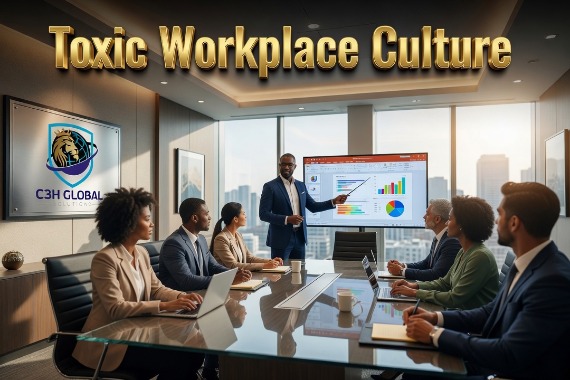
Toxic behavior at work survives on silence. That is starting to change. Here is how professionals are dismantling a broken culture with calm, precise language instead of open war.
By C3H Global Editorial | Published July 2, 2026 | 11 min read
For a long time, the advice about a toxic workplace culture came down to two options. You could keep your head down and absorb it, or you could quit and start over somewhere new, hoping the next place would be different. Both options put the entire burden on the individual, as if the problem were a personal failing rather than a feature of the environment. They also quietly assumed that the culture itself was fixed and that your only real power was the power to leave.
That assumption is breaking down, and it is breaking down across industries at the same time. Professionals are no longer treating disrespect as the cost of a paycheck. They are recognizing that toxic behavior is rarely the work of one bad actor in isolation, and that it survives because of a system that tolerates it. More importantly, they are learning that the most effective way to push back is not open conflict, but precise, professional language that interrupts the behavior without burning down the relationship or the career. This article is about that shift, why it is happening now, what it changes, and how you fit into it.
The Quiet Shift in What People Expect From Work
Something has changed in what people are willing to accept at work, and it did not arrive with a single announcement. It built slowly, through years of people comparing notes, naming experiences out loud, and refusing to pretend that certain behavior was normal just because it was common.
For decades, the unspoken deal was simple. You traded your tolerance for a steady income. If a manager belittled you in meetings or a senior colleague made you the regular target of their bad moods, that was filed under the general category of work, something to endure rather than address. The person who spoke up was often treated as the problem, while the person creating the problem kept their standing.
That deal is quietly being renegotiated. A growing number of professionals now expect dignity to come standard, not as a perk reserved for the lucky few who landed at a healthy company. They are asking a different question than their parents asked. The old question was whether a job paid enough to put up with the conditions. The new question is whether the conditions are worth a person's time at all, regardless of the pay. When enough people start asking that second question, the behavior that depended on silence loses its protection.
None of this means toxic behavior has disappeared. It clearly has not. What has changed is the assumption underneath it, the assumption that targets will stay quiet and that the culture cannot be challenged from the inside. That single assumption is now the thing under pressure.
Part of what fueled the shift is simply that people started talking to each other. For most of working history, the experience of being mistreated at work was a private one, something a person carried home and rarely compared with others. When workers began sharing those experiences more openly, a quiet realization spread. The behavior they had each privately blamed themselves for was not unique to them, and it was not a reflection of their own inadequacy. It was a pattern, repeated across companies and industries, and patterns can be named. Naming a thing is the first step toward refusing it, and a great deal of refusal is happening now that the naming has begun.
Why Toxic Behavior Is a System Problem, Not Just a People Problem
It is tempting to reduce a toxic workplace culture to a few difficult individuals, because individuals are easy to point at. The reality is more uncomfortable. Behavior that repeats over time is almost never sustained by one person alone. It is sustained by an environment that lets it continue without cost.
Consider how a pattern forms. The first time someone behaves badly, that tells you something about them as a person. If it happens again, and nothing in the environment pushes back, the second instance tells you something about the environment, because the system just demonstrated that the behavior is allowed. By the time it becomes a routine, you are no longer looking at a personality. You are looking at a culture that has been trained, one unchallenged moment at a time, to accept it.
This is why simply removing one difficult person rarely fixes anything for long. If the underlying system still rewards dominance, still treats silence as agreement, and still punishes the people who name problems, a new version of the same behavior tends to grow in the empty space. The behavior was never really about the individual. It was about what the environment permitted.
Seeing this clearly takes a heavy weight off your shoulders. If you have been carrying the private belief that you were too sensitive, or that you somehow invited the treatment you received, the systems view offers a more accurate story. You were operating inside an environment that had quietly normalized something it should not have. That is not a personal flaw. It is a design problem, and design problems can be changed.
What Research Generally Suggests About Psychological Safety
When you zoom out to why some teams thrive and others quietly corrode, one idea comes up again and again in organizational research. It is the concept of psychological safety, which describes whether people on a team feel safe enough to speak up, ask questions, admit mistakes, and raise concerns without fear of humiliation or punishment.
The general finding across this body of work is consistent and worth understanding. Teams where people feel safe to speak tend to perform better over time, learn faster from errors, and hold onto their people longer. Teams where speaking up feels dangerous tend to hide problems until those problems grow expensive, and they lose their most capable members first, because capable people usually have somewhere else to go.
Toxic behavior is corrosive precisely because it destroys psychological safety. Every unchallenged insult, every public humiliation, every comment designed to make someone smaller teaches the whole team a quiet lesson, which is that this is a place where you protect yourself by staying quiet. Once that lesson sets in, the team stops surfacing the very information it needs to function well. The cost is not only emotional. It is operational, and it shows up in worse decisions, slower learning, and steady turnover.
This is the part that connects individual dignity to organizational health. Protecting your own standing at work is not only good for you. When you interrupt toxic behavior with calm, professional language, you are also doing quiet repair work on the psychological safety of everyone around you, because you are demonstrating that the behavior can be met without catastrophe.
Language Is the Lever
Here is where the movement gets practical. If toxic behavior survives on silence and the expectation that targets will absorb it quietly, then the tool that breaks it is language. Not louder language, not angrier language, but more precise language, delivered with composure. People are discovering that they can fight back without going to war, and that the calm route is usually the one that works.
This is the heart of what professionals are using to push back, and it rests on three frameworks. We will keep this brief here, because each one is worth a deeper look, and you can find the full breakdown in our companion guides on how to respond to toxic coworkers and how to handle difficult people at work.
The first framework is The Statement. It names the gap between someone's behavior and the professional relationship, calmly and without accusation, which quietly puts the weight back on them to explain themselves. The second framework is The Question, which redirects responsibility by asking, without hostility, what you did to make such a comment seem acceptable, a move that works especially well when the other person outranks you. The third framework is The Disarming Apology, the most misread move of the three, which takes social responsibility without admitting fault and breaks the script a difficult person was counting on.
What makes these frameworks part of a larger movement is what they share. None of them is about winning, and none of them requires you to become aggressive or cruel. Each one is about clarity, about establishing where you stand and what you expect, and about refusing to supply the reaction that toxic behavior runs on. When one person uses them, those frameworks protect that individual. When they become normal across a team, they slowly change what the culture tolerates. That is how language becomes a lever rather than just a coping skill.
There is a reason the calm approach outperforms the explosive one, and it is worth naming directly. An angry outburst, however justified it feels in the moment, hands the difficult person an easy story to tell about you. It lets them point at your reaction instead of their behavior, and it gives the surrounding system a reason to treat you as the problem. Composed, precise language denies them that story entirely. It keeps the focus exactly where it belongs, on the behavior and on the gap between that behavior and a professional relationship. This is why language, used with discipline, is more powerful than volume. It protects your standing while it makes the other person's choices visible to everyone in the room.
Why Mission Driven and Veteran Owned Organizations Build Differently
Not every organization treats dignity as optional, and the ones that take it seriously tend to share a certain origin story. Many of them were built by people who knew firsthand what it costs to be overlooked, dismissed, or treated as disposable, and who decided to build something that would not repeat that.
C3H Global Solutions is a veteran owned company, and that background is not a marketing line. It shapes how the company sees the people it serves. Military experience teaches, in direct terms, that a team is only as strong as the trust inside it, that people perform best when they know they are valued and protected, and that dignity under pressure is a discipline rather than an accident. Those lessons carry straight into how a mission driven organization thinks about work, about hiring, and about the people navigating hard seasons in their careers.
That perspective is why C3H builds the way it does. The company exists for professionals who have had to fight for their seat at the table, people who know what it feels like to be the target and who want tools that actually work rather than empty encouragement. A mission driven organization does not treat workplace dignity as a soft topic. It treats it as foundational, because it understands that people who feel respected do better work, build better teams, and create better outcomes for everyone around them.
Choosing a Professional Community That Actually Has Your Back
One of the most underrated choices in any career is the decision about which community a person chooses to stand inside. For a long time, professionals were expected to navigate everything alone, to absorb the hard moments privately and figure out the rest by trial and error. That isolation was part of what allowed toxic behavior to keep its power, because a person who feels alone is far easier to wear down than a person who knows they have support.
Choosing a professional community that genuinely supports you changes that equation. The right community gives you language for the moments that used to leave you speechless. It gives you a place to find better opportunities when the current situation is not worth your time. It connects you with people who have walked through the same rooms and come out steadier. The point is not to replace your own judgment, but to make sure you never have to face the hard parts of working life without backup.
This is the role C3H aims to play for the people it serves. The platform brings together open roles for those ready to find something better, services and digital products built to help people grow their skills and income, and a broader community oriented around the simple belief that working professionals deserve dignity and opportunity at the same time. Choosing where you stand is a quiet form of power, and it is one more way professionals are pushing back against cultures that took their silence for granted.
Frequently Asked Questions
Is toxic workplace culture really a systemic problem or just a few bad people? It is usually systemic. While individuals start the behavior, it only repeats and spreads when the surrounding environment tolerates it without consequence. Removing one difficult person rarely fixes a toxic culture for long, because a system that rewards the behavior tends to produce more of it.
What is psychological safety and why does it matter at work? Psychological safety describes whether people feel safe to speak up, ask questions, and admit mistakes without fear of humiliation or punishment. Research generally suggests that teams with high psychological safety perform better, learn faster, and retain their people, while teams without it tend to hide problems and lose their strongest members.
How can I push back against toxic behavior without making things worse? Use calm, precise, professional language rather than open confrontation. Naming the gap between someone's behavior and the professional relationship, asking a redirecting question, or offering a disarming apology can interrupt the behavior without escalating it. These approaches protect your standing while keeping the situation from turning into a war.
Why do veteran owned and mission driven companies approach workplace dignity differently? Many were founded by people who experienced firsthand what it costs to be overlooked or treated as disposable, and who built their organizations to avoid repeating that. That background tends to make dignity, trust, and respect foundational rather than optional, because the founders understand directly how much those things affect performance and loyalty.
Does one person speaking up actually change a workplace culture? It can contribute to real change. When one person calmly demonstrates that toxic behavior can be met without catastrophe, it lowers the perceived risk for others and chips away at the silence the behavior depends on. Culture shifts when enough individuals stop tolerating what used to go unchallenged.
The Shift Is Already Underway, and You Are Part of It
The most hopeful thing about this moment is that it does not depend on permission from the top. A toxic workplace culture loses its grip the moment the people inside it stop treating silence as the only option, and that change starts with individuals who decide they are done absorbing disrespect as the price of a paycheck. You do not have to wait for leadership to fix it, and you do not have to go to war to challenge it. You only have to bring clarity, composure, and language to the moments that used to leave you frozen.
That is the quiet revolution happening across workplaces right now. Professionals are fighting back with words instead of weapons, protecting their own dignity while slowly raising the standard for everyone around them. It is not loud, and it does not make headlines, but it is real, and it is working.
C3H Global Solutions was built for the people leading that shift. If you are ready to protect your standing and find an environment that values you, explore open roles on our jobs board at https://www.c3hglobal.com/jobs. You can also browse the services and digital products built to help you grow at https://www.c3hglobal.com/services and https://www.c3hglobal.com/digital-kits, and see everything we offer at www.c3hglobal.com.