What Nobody Tells You About Responding to Toxic Coworkers and the Three Phrases That Change Everything

Written by the team at C3H Global Solutions Editorial Team | 13 min read
Workplace advocacy, career strategy, and professional communication
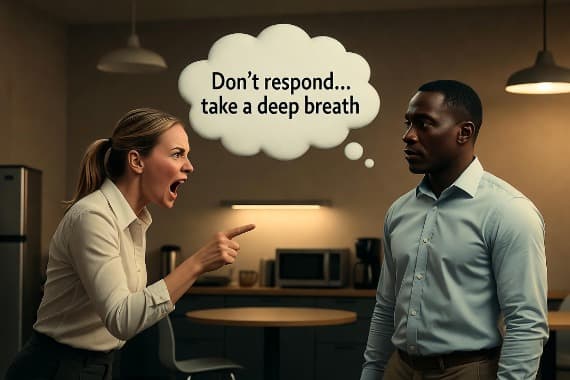
There is a specific kind of silence that follows a comment meant to make you small. Someone says something sharp in a meeting, or drops a remark in the hallway that lands like a slap, and the room keeps moving while you stay frozen in place. Your face goes hot. A response forms somewhere in your chest but never reaches your mouth. By the time the right words finally arrive, the moment has passed, and you are left replaying it on the drive home, rehearsing what you should have said to a person who stopped listening hours ago.
If you have lived that moment, you already know the question that follows you home. Why did I just stand there? Most advice on how to respond to toxic coworkers skips straight to clever comebacks and never explains the freeze itself, and the freeze is the part that actually keeps people stuck. So that is where we are going to start. We will get to the phrases, but first we need to look at why your body betrays you in the exact moment you need it most, because once you see the machinery underneath, everything else gets easier.
The Freeze Is Not a Character Flaw
The freeze feels like weakness. It is not. It is biology doing precisely what it evolved to do.
A cutting remark in front of colleagues registers as a status threat, and your nervous system reads that threat the same way it reads physical danger. Blood moves toward your large muscles. The part of your brain responsible for measured speech goes quiet while the part responsible for survival takes the wheel. You are not choosing silence in that moment. Your body is choosing it for you, and it reaches for the oldest option in the book, which is to go still and wait for the threat to pass.
This is why willpower alone never fixes the problem. You cannot think your way out of a reaction that fires before thought even arrives. The people who appear unshakable under pressure are rarely braver than you are. They have simply trained their bodies to stay regulated long enough for their minds to catch up, and that kind of training is something anyone can learn. It is the foundation that everything else in this article rests on.
So the first thing to set down is the shame. The fact that you froze does not mean you are timid or that you lack self respect. It means you are human, working with a nervous system that has not yet been handed a better script to run. The goal ahead is not to become a different person. The goal is to give that nervous system somewhere to go.
Why Toxic Behavior Works in the First Place
Here is the part nobody explains. Toxic behavior at work is rarely random, and it is almost never really about you. It is a strategy, even when the person using it could never put that strategy into words.
People who repeatedly belittle, undermine, or needle others are usually chasing a feeling of power, and the cheapest way to feel powerful is to pull a reaction out of someone else. Your shock is the payoff. Your stammer is the payoff. Even your silence is a payoff, because it quietly confirms that the tactic worked and that you are a safe place to do it again. The behavior keeps going because it keeps producing the exact result the person is hunting for, often without their conscious awareness.
That single insight reframes the whole situation. You are not in a conflict about the comment. You are in a transaction, and the currency is your emotional reaction. The moment you stop paying, the transaction falls apart.
The pattern most people miss
There is a pattern worth naming clearly, because seeing it changes how you carry the weight of these moments.
The first time someone disrespects you, that tells you something about who they are. The second time tells you something about the environment you are standing in, because the first instance was allowed to pass without any cost. By the third and fourth and fifth time, you are no longer dealing with a person who slipped. You are dealing with a pattern that has been quietly trained into place, and every silent absorption taught that person the same lesson, which is that the behavior is free.
What gets tolerated gets repeated. That is not a motivational slogan. It is a plain description of how human systems actually work. Behavior that carries no cost will not stop on its own, and waiting for the other person to grow a conscience is a strategy that keeps you waiting forever. The only reliable way to interrupt the cycle is to make the behavior cost something. The genius of doing it well is that the cost can be entirely social and professional. You never have to raise your voice, and you never have to become the thing you are responding to.
Before the Words, There Is the Body
The fastest way to lose a difficult moment is to speak before your body is ready. This is the layer almost everyone skips, and it is the layer that makes everything else possible.
When a comment lands, the instinct is to shrink. Your shoulders curl inward, your chin drops, and your eyes start looking for an exit. Every one of those signals tells the room, and tells the person who targeted you, that the hit connected. So your first move is physical, and it happens before you say a single word. Turn and face the person fully. Square your shoulders, keep your chin level, and hold your eyes forward. The posture should not look aggressive or wide eyed or braced for a fight. It should simply look settled. That kind of stillness communicates something words cannot, which is that you received the comment and it did not move you.
Your voice carries as much weight as your stance. A lot of people lose their footing in these moments not because of the words they chose but because of how those words came out, thin and high and rushed. The fix is something we call the grounded tone, and you can find it long before you ever need it. Drop your chin gently toward your chest and say the words "I see." Say them again. Notice where the sound is coming from, somewhere low and settled in your chest rather than tight in your throat. Now say it one more time while you slowly lift your chin back to level. That low, unhurried place is exactly where you want to land whenever the temperature in a room starts to rise. Confident people are never in a hurry to answer. They take the space they need, and the space itself reads as authority.
Then there is the single most underused tool in any tense exchange, which we call the two second pause. After someone says something designed to provoke you, do not fire back. Instead, you pause, you hold their gaze, and you let the silence sit. Most people find silence so uncomfortable that they rush to fill it, and the way a person fills that silence almost always reveals their intent or their insecurity. So let them keep talking. Let them overexplain. Very often they will dig the hole deeper while you simply stand there, composed and gathering information. When you finally do respond, you respond from that grounded, squared, unhurried place, and you respond on your terms instead of theirs.
If you are quietly weighing your exit, that is not a failure. It is information. See who is hiring at https://www.c3hglobal.com/jobs.
The Three Phrases That Change Everything
Composure buys you the room to speak. What you say inside that room is where the three phrases come in. These are not lines to memorize and recite word for word. They are frameworks to internalize, so that something steady comes out of your mouth instead of the silence you used to default to.
1. The Statement
The first phrase is the statement, and it is built for the moments when a remark has clearly crossed a line. It might be something personal, something dismissive, or the kind of comment that would make anyone in the room uncomfortable if they stopped to think about it. The statement works best when that comment was made in front of others, because public moments are where this behavior tends to thrive. The person is counting on your shock and your silence to carry the room for them.
The statement sounds like this. "I want to be straight with you. That caught me off guard. The way I have understood our working relationship, it has always been professional, and what you just said did not fit that." Then you stop talking. You do not laugh it off, and you do not soften it. You return to the pause and you let it land.
Notice what the statement is doing. It names the gap between the behavior and the professional context without accusing, threatening, or escalating anything. You are not declaring the comment inappropriate, and you are not issuing a demand. You are calmly describing a disconnect, which quietly shifts the weight back onto the other person to explain themselves. You are also refusing to match their energy, and that refusal is the whole point. The instant you go sarcastic or perform outrage, you hand them the reaction they came for. Calm, specific, dignified language pulls the fuel right out of the fire.
If they deflect, and they often will with something like "relax, it was a joke" or "you are being too sensitive," you do not chase the bait. You stay in your lane. "I hear you, and maybe I read it wrong. To me this has always been a professional relationship, so I wanted to be clear about where I stand." You are not debating their interpretation. You are anchoring to your own position and repeating it without any heat, which is exactly what composure under pressure looks like. It is remarkably hard for anyone to keep pushing against a person who simply will not be moved.
2. The Question
The second phrase is the question, and it shines when the person targeting you holds some degree of status. Maybe it is a senior colleague, or a manager, or anyone who could reframe your pushback as you overreacting if you challenge them too directly. The question sidesteps that trap entirely.
It sounds like this. "Let me ask you something. What have I done that made a comment like that feel okay between us?" Read it slowly, because the construction is doing precise work. You are not telling them they did something wrong. You are asking what you did to create the dynamic, which forces them to either own the comment, justify it out loud, or back away from it altogether. People who needle others at work are counting on quiet absorption. The moment you ask them to explain, in their own words, why they felt that was acceptable between the two of you, the floor shifts under their feet.
If they go defensive with something like "I was just being friendly," you have a clean follow up ready. "I appreciate that. I just want us on the same page about how I work best, so if I ever seem to invite a different kind of dynamic, I would want to know." There is no accusation in that, and no confrontation. It is just a firm, quiet signal that you saw what happened and you are not pretending you did not.
This approach also works beautifully one on one, in a hallway after a meeting or in a quiet moment when the audience is gone. People behave very differently when there is no one left to perform for. Never underestimate the value of pulling someone aside and asking that question calmly, just the two of you.
3. The Disarming Apology
The third phrase is the one most people misjudge, so stay with it before you dismiss it. It is the disarming apology, and it is not surrender. It is one of the most advanced moves in professional communication, and when you deliver it well, it can completely disorient someone who expected you to either crumble or explode.
It sounds like this. "If I have done anything that made this kind of exchange feel acceptable between us, I want to apologize, because that is genuinely not what I am after. I have nothing against you. I have always seen this as a professional relationship. If something specific is bothering you, I am open to hearing it."
Look closely at what that language is doing. You are taking social responsibility without ever admitting fault. You state your real values out loud, which are professionalism, mutual respect, and no ill will. You invite accountability from the other person without demanding it. And you make it remarkably hard for any reasonable person to keep attacking someone who just responded with that much grace.
Here is the effect it has on a difficult person specifically. They came in running a script with two expected endings, which are you shrinking or you fighting. When you do neither, when you respond with openness and even extend a small olive branch, the script breaks in their hands. Many people will back down on the spot, because suddenly they have nothing to push against. The ones who keep coming, even after such a gracious response, have now revealed their intent unmistakably, both to you and to everyone watching, which hands you information you did not have before.
The one condition is that it has to be real. You cannot deliver these words through clenched teeth and expect them to work. The power comes from actually meaning them, from understanding that how you respond to ugliness is a reflection of your character and not theirs. The disarming apology works because it separates you completely from the behavior you are receiving.
What These Phrases Are Really Doing
It is worth being honest about what success looks like here, because the goal is not what most people assume it to be.
None of these three phrases is about winning. Every one of them is about clarity. Each phrase establishes, calmly and unmistakably, where you stand, what you expect, and how you intend to operate no matter what anyone throws at you. When you know that about yourself and you can say it without flinching, most people quietly stop testing you. They move on to easier targets, because you have stopped being a free source of the reaction they were hunting for.
The few who do not stop end up revealing something important. Their persistence past a calm, generous, professional response is no longer ambiguous, and it stops being a question of interpretation. It becomes information you can act on. You now know exactly what you are dealing with, and you can decide your next step from a place of clarity rather than confusion. Either way, you win back the very thing the freeze took from you, which is the sense that you have a say in how you are treated.
One more thing belongs here. After any of these exchanges, whether it went smoothly or felt clumsy, resist the urge to spend the next three hours dissecting it in your head. You showed up. You responded. That alone places you in a completely different category from the version of you who swallowed these moments in silence for months. Progress in how you communicate is never a straight line, and the first attempt will probably feel awkward. Do it anyway, because the version of you who has practiced this a dozen times in low stakes moments is the version who stays composed when it truly counts.
Frequently Asked Questions
How do you respond to a toxic coworker without looking unprofessional? You respond with calm, specific, dignified language instead of emotion. Square your posture, find a grounded tone, take a brief pause, and then name the disconnect between their behavior and the professional relationship without accusing or escalating. Composure is what keeps you on the right side of the line.
What should you say when someone disrespects you in front of others? Use a clear statement that names the gap. Tell them the comment caught you off guard because the relationship has always been professional, and then stop talking and let the silence do the work. Public composure protects your reputation far better than a sharp comeback ever could.
Is it ever a good idea to apologize to someone who is mistreating you? Yes, when you do it as a deliberate strategy rather than an admission of fault. A disarming apology takes social responsibility, states your values, and invites the other person to explain themselves. It breaks the pattern a difficult person expects and often stops the behavior without any confrontation at all.
Why do I freeze when a coworker says something hurtful? You freeze because your nervous system reads a status threat the same way it reads physical danger, and it shuts down measured speech to prioritize survival. The freeze is biology rather than weakness, and it can be retrained with practice and preparation.
How do you stop a coworker from disrespecting you repeatedly? You make the behavior cost something socially and professionally, using calm language that refuses to supply the reaction they want. Behavior that carries no cost gets repeated, so interrupting the pattern means responding with the same steady composure every single time it happens.
You Already Have More Than You Think
The reason these moments cut so deep is that they touch the oldest worry most working people carry, the fear of not being valued, not being seen, and not being protected in the place where you spend most of your waking hours. That fear is real, and pretending it away helps no one. But it is not the end of your story.
Learning how to respond to toxic coworkers is not about becoming hard, cold, or combative. It is about reclaiming your professional dignity one calm sentence at a time, with a statement that anchors you, a question that redirects responsibility, and an apology that disarms without surrender. You do not have to absorb disrespect in silence just because someone holds a title, or just because the culture around you decided that this is normal. You have every right to protect your standing, clearly and steadily, without losing yourself in the process.
C3H Global Solutions exists for professionals who refuse to be overlooked. We build the tools, the community, and the opportunity for people who have felt that sting and decided they are done staying quiet about it. Explore everything we offer at www.c3hglobal.com.