Interview Questions Employers Can Ask Instead of the Risky Ones
Most hiring managers believe the safest interview is a careful one. It's actually a boring one: the same questions, in the same order, scored the same way, no matter who walks in.
Employers can ask about the skills, experience, availability, and work authorization a job requires. Instead of asking about age, family, religion, health, or national origin, describe the job's real requirements and ask whether the applicant can meet them. Ask everyone identical questions and score each answer against one rubric.
Here's why that matters. If you run a small business, you probably interview between a supplier call and payroll, with no HR department reviewing your questions first. Interviews rarely go wrong because a manager sets out to discriminate. They go wrong because someone tries to be friendly, fills a quiet moment with small talk, or follows a hunch about whether a candidate will "fit." One question about kids or a graduation year, and suddenly the company has a note in a file it would rather not explain.
An employment attorney who reviews these situations boiled the whole test down to one question in a recent video: why do you want to know? If you can answer that with something the job actually requires, you can almost always find a way to ask. If you can't, the question goes. Nobody has ever landed in a deposition for asking about spreadsheet skills.
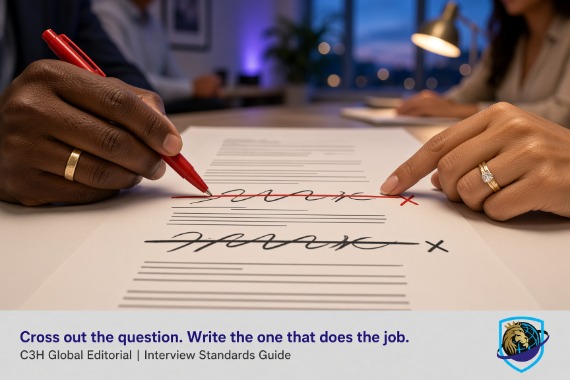
This guide takes ten questions that still turn up in interviews, marks them up with a red pen, and rewrites each one to get you the information you were really after.
What interview questions can employers legally ask?
Federal guidance gives you a simple standard. The EEOC says information gathered before hiring should be limited to what's essential for deciding whether someone is qualified, and that other questions can be used as evidence of an intent to discriminate unless the employer can justify them. Before you ask anything, run it through three checks:
Which interview questions should employers rewrite?
Nearly every rewrite below follows one formula: state the requirement, then ask whether the candidate can meet it. When you catch yourself reaching for a personal question, find the job concern hiding behind it and ask about that instead.
What Is Actually Inside
- A three check test you can run on any interview question in seconds.
- Eight strong interview questions and five small talk swaps.
- Ten common questions marked up and rewritten to stay about the job.
- A quick reference table for the topics that cause the most trouble.
- How to build a structured interview, with a sample scoring rubric.
- Note taking rules that hold up if anyone ever reads them.
| Topic | Avoid asking | Ask instead | Law involved |
|---|---|---|---|
| Age | How old are you? When did you graduate? | Are you at least 18? (only when legally required) | ADEA |
| National origin | Where were you born? Is English your first language? | Are you authorized to work in the U.S.? Are you fluent in the language this role uses? | Title VII |
| Disability and health | Do you have any medical conditions? | Can you perform these essential functions, with or without accommodation? | ADA |
| Family | Do you have kids? Are you planning a family? | Can you work the posted schedule? | Title VII (sex) |
| Religion | Which holidays do you observe? | Can you work the required weekend and holiday rotation? | Title VII (religion) |
| Criminal history | Have you ever been arrested? | Job related convictions, at the stage local law allows | Title VII, state and local law |
| Pay | What did you earn at your last job? | What pay range are you targeting? | State and local law |
What are good interview questions to ask every candidate?
Rewriting risky questions is half the job. The other half is asking strong ones. These eight work for most roles, and every one is about the work:
- Experience: "Walk me through a project from your last role that's closest to what this job involves."
- Problem solving: "Tell me about a problem you solved that nobody asked you to fix."
- Reliability: "Describe a time you were about to miss a commitment. What did you do?"
- Communication: "Tell me about a time you had to explain something complicated to a customer or coworker."
- Feedback: "What's the most useful criticism you've received at work, and what did you change?"
- Teamwork: "Describe a disagreement with a coworker and how it got resolved."
- Skills: "Show me how you'd approach [a short, real task from the job]."
- Motivation: "What made you apply for this role, and what would make you stay?"
Where does small talk get interviewers into trouble?
Most risky questions don't come from the official list. They slip out in the friendly minutes before the interview starts. Keep the warm up warm, and keep it about today:
| Skip this | Say this instead |
|---|---|
| "Where are you from originally?" | "Did you find the office okay?" |
| "Is that a wedding ring? Congratulations!" | "Thanks for making time today." |
| "When are you due?" | "Can I get you some water before we start?" |
| "What church do you go to?" | "Have you had a chance to look at our website?" |
| "You look young for this role." | "Let me tell you a little about the team." |
How do you structure an interview so every candidate gets a fair shot?
The U.S. Office of Personnel Management describes a structured interview as one that follows rules for asking, observing, and evaluating responses. At its most structured, every applicant answers the same predefined questions and is scored against the same benchmarks. OPM reports that more structure brings higher validity, stronger agreement between interviewers, and less adverse impact. In plain terms, it predicts job performance better and treats people more evenly.
OPM also notes an honest catch: interviewers and applicants tend to prefer looser conversations. Unstructured interviews feel more natural. They're also where the off script questions live.
Build your interview kit in five parts
- Five to eight core questions drawn from the job description, asked of every candidate in the same order. Improvisation is wonderful at a comedy club. In an interview, it's where lawsuits find their material.
- Planned follow ups, such as "What was the result?" or "What would you do differently?" so interviewers can dig deeper without improvising.
- A scoring rubric with a short description of what a weak, solid, and strong answer sounds like.
- A notes sheet with space for each question and nothing else.
- A ten minute briefing before interviews start, so every interviewer knows the questions, the rubric, and the topics that stay off the table.
Sample rubric for one question
"Tell me about a time you had to meet a deadline that changed suddenly."
| Score | What the answer sounds like |
|---|---|
| 1, Weak | Speaks in generalities, gives no example, or describes missing the deadline without a plan. |
| 3, Solid | Gives a real example, explains the steps taken, and reports the outcome. |
| 5, Strong | Gives a specific example, shows how they reprioritized and communicated, reports a measurable result, and names what they'd repeat. |
A great interview kit needs great candidates to interview.
Your job posting is really the first interview question. The C3H Global posting form includes fields for job type, location, salary range, experience level, skills, and required certifications, so applicants can see the real requirements before they apply. Choose Sign up and select the Recruiter role to post. See Recruiter plans.
What should an interviewer say when a candidate volunteers personal information?
People share things on their own all the time. Someone mentions their kids, their church, or an upcoming surgery to make conversation. You didn't ask, but now you know. Don't follow up, don't write it down, and steer back to the job:
"Thanks for sharing that. Let's get back to the role. Tell me about the last project you led."
Then make sure the information stays out of the evaluation. The attorney in the video points out that when hiring decisions are questioned, investigators want to know who learned what, and whether it reached the person who made the call.
What should interviewers write down?
- Write what the person said and did, not your impression of who they are.
- Skip personal descriptors. Words like "young," "older," "pregnant," "foreign," or "family guy" have no place in interview notes.
- Swap "culture fit" for specifics. If someone seemed like a poor fit, name the job related reason, such as "no experience managing vendors."
- Interview in pairs when you can. A second interviewer keeps the conversation on script and gives you two independent scores to compare.
- Score before you compare. Rate each answer against the rubric before discussing candidates as a group, so the loudest voice in the room doesn't set the scores.
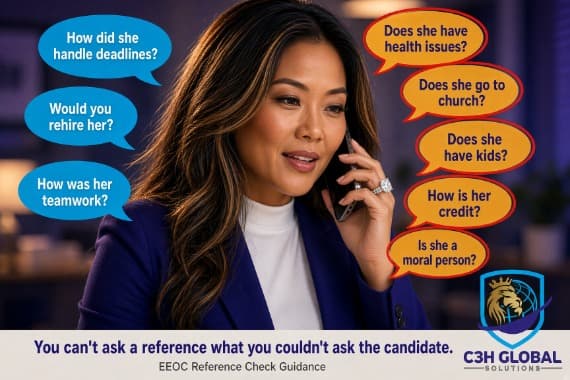
Want the other side of the table? Our guide to illegal interview questions shows what candidates are learning to listen for, and our reference check guide keeps the final stage just as clean.
Who and what does this article cover?
- EEOC: The U.S. Equal Employment Opportunity Commission, which enforces federal laws against job discrimination.
- Americans with Disabilities Act (ADA): The law restricting disability questions before a conditional job offer.
- Title VII of the Civil Rights Act: The law prohibiting discrimination based on race, color, religion, sex, and national origin.
- Essential functions: The fundamental duties of a job, which candidates can be asked about directly.
- Reasonable accommodation: A change in how work is done that lets a qualified person with a disability perform the job.
- Structured interview: An interview where every candidate answers the same questions and is scored against the same benchmarks.
- Office of Personnel Management (OPM): The federal agency that publishes guidance on hiring assessments, including structured interviews.
- Salary history ban: State or local laws that prohibit employers from asking about a candidate's past pay.
Questions employers ask about interview questions
What questions can an employer legally ask in an interview?
Employers can ask about skills, experience, education related to the job, availability, willingness to meet schedules and travel, licenses, and whether a candidate is authorized to work in the United States.
Can an employer ask about a candidate's disability?
Not before a conditional job offer. You can describe the essential functions of the job and ask whether the applicant can perform them, with or without reasonable accommodation.
Can an employer ask if a candidate is a U.S. citizen?
The safer question is whether the person is legally authorized to work in the United States and whether they will need visa sponsorship. Questions about birthplace or ancestry can raise national origin concerns.
What are good interview questions for employers to ask?
Questions about real work: a past project close to the role, a problem the person solved, a time they nearly missed a commitment, how they handle feedback, and a short task from the job itself. Ask every applicant the same ones.
Can I ask a candidate about their availability on weekends?
Yes. State the schedule the job requires and ask whether they can work it. Avoid asking why someone might not be available, such as religious or family reasons.
Where can I post a job and find candidates?
Choose Sign up on C3H Global and select the Recruiter role to post openings. Compare options on our pricing page, and see current listings on the job board.
Your turn with the red pen
- Pull up the questions your team used in its last round of interviews.
- Run each one through the three checks. Strike anything that fails.
- Rewrite what's left so it describes a job requirement and asks whether the candidate can meet it.
- Add a rubric line to each question, then share the kit with every interviewer.
One more hint: put the pay range in the posting itself. Some states and cities now require it, and it answers the question candidates most want to ask before they ever apply.
When your kit is ready, post your opening on C3H Global and put it to work.
This article is general information, not legal advice. Federal discrimination laws generally apply to employers with 15 or more employees (20 or more for age discrimination), and many state and local laws cover smaller employers and add protections, including limits on salary history and criminal history questions. The attorney's comments are described as her perspective. Review your hiring process with an employment attorney licensed in your state.
Sources
- U.S. Equal Employment Opportunity Commission, "Prohibited Employment Policies and Practices." eeoc.gov
- U.S. Equal Employment Opportunity Commission, "Enforcement Guidance: Preemployment Disability Related Questions and Medical Examinations." eeoc.gov
- U.S. Equal Employment Opportunity Commission, "Pre-Employment Inquiries and Marital Status or Number of Children." eeoc.gov
- U.S. Equal Employment Opportunity Commission, "Pre-Employment Inquiries and Religious Affiliation or Beliefs." eeoc.gov
- U.S. Equal Employment Opportunity Commission, informal discussion letter on age inquiries under the ADEA. eeoc.gov
- U.S. Equal Employment Opportunity Commission, "Enforcement Guidance on the Consideration of Arrest and Conviction Records in Employment Decisions," April 25, 2012. eeoc.gov
- U.S. Office of Personnel Management, "Structured Interviews." opm.gov
- Employment attorney commentary, "These Job Interview Questions Could Get Employers in Trouble," YouTube. youtube.com