Nine One Person Businesses, and How to Work Out Which One Is Yours

Nine viable options is not nine times better than one. It is paralysis. Two questions cut this list down to a short list you can actually act on, and you can answer both in ten minutes.
Nine businesses with more demand than competition, each with a full build guide behind it. Two questions sort them: what you can spend to be legally open, and whether you are willing to be the labor for the first ninety days. Answer both and six of the nine disappear. What remains is a short list you can research properly.
Start here: the sort
Question one: what can you spend to be legally open?
Not what you can raise eventually. What you can put on the table this quarter to reach the point where taking money is legal.
That figure includes the entity, the insurance, the licenses, the registrations and the first piece of equipment. It does not include the money you hope will arrive from your first customer, because in several of these businesses your first customer is months away from existing.
Two bands are enough. Under ten thousand, or more than that.
Question two: will you be the labor for the first ninety days?
Some of these you do with your own hands. Others require you to find, vet, schedule and keep somebody else who does it, from roughly week one.
Neither answer is better. They are different businesses that happen to be on the same list, and the most common expensive mistake is choosing one while wanting the other.
Yes, I will do the work, or no, somebody else will.
Two questions, four quadrants, nine businesses. Find your quadrant and read the two or three inside it. Ignore the rest.
Which quadrant are you in?
Lower capital to open · You do the labor
Own a Trade
You learn a skill and sell it directly. Slowest to master, cheapest to start, and the income has a ceiling shaped like your own calendar.
Lower capital to open · Somebody else does the labor
Broker the Work
You match people to work and take a position in the middle. Cheapest of all to open, and the whole business is your ability to find and keep people.
Higher capital to open · You do the labor
Buy a Route
Equipment and registration up front, recurring revenue after. You drive, service and invoice until volume justifies a second person.
Higher capital to open · Somebody else does the labor
Build the System
Heaviest to stand up, most licensing, and you are running an operation rather than doing a job from the first week.
This is the C3H Two Axis Sort, and it is the same instrument we use with clients who arrive holding a list of options rather than a decision.
Own a Trade
Lower capital, you do the work.
You are buying yourself a skill and a customer base. Entry is cheap, the learning curve is real, and you will be the one holding the tools for a long time. The ceiling is your own hours until you hire. The floor sits higher than most people expect, because trades with an aging workforce do not have many people arriving to replace them.
Small engine repair
Mowers, generators, chainsaws, pressure washers and line striping machines, for landscaping crews and contractors whose equipment failure costs them a working day.
The gate: none, in most places. No license required to perform repairs, though business licensing applies as it would anywhere. Manufacturer authorization matters commercially because it unlocks warranty work.
What the data says: the Bureau of Labor Statistics counts roughly 78,000 small engine mechanics and projects about 7,600 openings a year. Many of those come from people leaving the trade rather than the work drying up. Median pay was $48,240 in May 2024.
The honest catch: seasonality. Spring and summer are packed and winter is thin unless you plan for it deliberately.
Full build guide: How to Start a Small Engine Repair Business
Fire extinguisher inspection
Annual maintenance checks on portable extinguishers across restaurants, apartment buildings, warehouses and institutions. You hang the tag, you come back in twelve months, and you keep coming back.
The gate: real, and it is the point. Most states require two credentials, a license for the company and a certification for each technician, issued through the state fire marshal. Exams are typically built on NFPA 10 plus state rules.
What the law says: OSHA requires employers to have extinguishers maintenance checked annually and to keep the record. Your customer is not deciding whether to buy, only who from, and they decide again every year.
The honest catch: small tickets. The business is built account by account over years, and the route only becomes valuable once it is dense.
Full build guide: How to Start a Fire Extinguisher Inspection Business
Buy a Route
Higher capital, you do the work.
Equipment and registration go in first, then recurring revenue arrives and keeps arriving. These are the businesses where the capital requirement and the paperwork are doing the same job a license does elsewhere, which is keeping the field thin enough that the operators in it do well.
Portable sanitation
Units placed at construction sites and events, serviced on a schedule, billed monthly per unit.
The gate: disposal access decides everything. Waste is classified by the EPA as domestic septage under 40 CFR Part 503 and has to go to a permitted receiver. If there is no receiving facility within a workable drive, the business does not exist in your area at any price. Add state hauler registration and a possible commercial driver's license depending on truck weight.
What the law says: OSHA requires construction employers to provide toilets on site, scaled to crew size, and a unit in unsanitary condition does not satisfy the requirement. The servicing is part of the compliance.
The honest catch: it is physical, outdoor, all weather work involving waste. That is the actual barrier, and it is precisely why competition stays thin.
The whole build: How to Start a Portable Toilet Rental Business
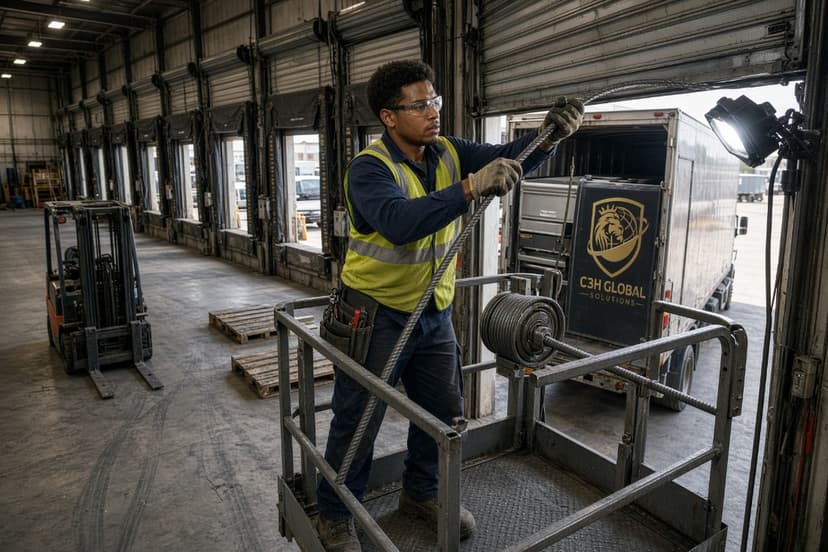
Commercial dock and door service
Dock levelers, roll up doors, seals, vehicle restraints and controls at warehouses and distribution centers. Emergency repair at premium rates, plus quarterly maintenance contracts.
The gate: no single national license, but electrical scope may require a licensed electrician depending on jurisdiction, and distribution centers run vendor onboarding with insurance minimums before you are allowed on site.
What the law says: OSHA's dockboard standard requires this equipment to be designed, constructed and maintained to prevent transfer vehicles running off the edge. That word maintained is your service, written into a federal regulation.
The honest catch: genuinely hazardous. Hydraulic pressure and spring tension release suddenly when serviced by somebody who assumed a still machine was a safe one.
Inside the trade: How to Start a Loading Dock Equipment Service Business
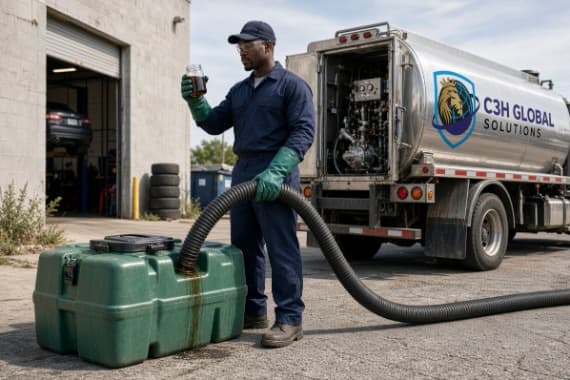
Waste oil collection
Used motor oil collected from auto shops, fleets and small manufacturers on a schedule, then delivered to a permitted processor.
The gate: the heaviest on this list. Transporters must obtain an EPA identification number under 40 CFR Part 279, plus state registration and DOT compliance, and you may only deliver to receivers who themselves hold an EPA identification number.
Why it is here anyway: you get paid twice at the same stop. The generator pays you to take the oil, then a processor pays you for the oil.
The honest catch: highest capital entry of the nine, and half your revenue floats with commodity prices. Price the pickup fee to carry the business on its own.
Inside the trade: How to Start a Used Oil Collection Business
Broker the Work
Lower capital, somebody else does the labor.
Cheapest quadrant to open and the one people underestimate most. You are not avoiding work by choosing this. You are trading physical work for the work of finding, vetting and keeping people, which is a genuine skill that most people discover they do not have around month four.
Truck driver recruiting
Sourcing and placing commercial drivers for carriers, in an industry whose hiring demand is driven by turnover rather than growth.
The gate: none beyond ordinary business setup. No license, no equipment, no premises.
What the data says: BLS projects about 237,600 openings a year for heavy and tractor trailer truck drivers between 2024 and 2034, more than any other occupation at that education level. Many of those openings come from people leaving rather than positions being created. Median pay was $57,440 in May 2024.
The honest catch: it is the purest people business on the list. There is nothing to hide behind. If you cannot find and keep candidates, there is no business underneath.
Remote cleaning
Residential and commercial cleaning coordinated by you and performed by independent cleaners you recruit, schedule and manage.
The gate: low. Business setup, insurance, and whatever local licensing applies to cleaning services in your area.
The honest catch: the failure mode is specific and common. When the owner cannot recruit reliable cleaners, they start cleaning themselves, and the moment that happens the model has ended. You have not built a cleaning company. You have bought yourself a cleaning job with extra admin.
Build the System
Higher capital, somebody else does the labor.
Heaviest quadrant on both axes. Real licensing, real capital, and you are running an operation rather than doing a job from week one. These are businesses, not self employment, and they should be entered on purpose rather than by drifting into them.
Non emergency medical transportation
Scheduled transport for patients to dialysis, treatment and appointments, contracted through facilities and brokers.
The gate: heavy and state specific. Vehicle standards, driver credentialing, insurance minimums, and broker or payer credentialing processes that take months.
The honest catch: the driver is the product. A missed dialysis pickup does not produce a complaint, it produces the permanent loss of a facility relationship. Reliability is not a service quality issue in this business, it is the whole business.
Foundation repair and waterproofing
Structural and water intrusion work on residential property, sold by you and performed by a licensed crew.
The gate: contractor licensing, which is state specific and often requires demonstrated experience, examination and bonding. Whether you hold it or contract with somebody who does changes the entire shape of the business.
The honest catch: crew availability decides your revenue. The week you close three jobs is the week you discover whether your crew is booked, and work performed badly by a crew you did not vet is a problem you remain responsible for.
The whole list, side by side
| Business | Quadrant | Capital to open | Licensing gate | Speed to first customer | Who does the work |
|---|---|---|---|---|---|
| Truck driver recruiting | Broker the Work | Lowest | None beyond business setup | Fast | Candidates and carriers |
| Remote cleaning | Broker the Work | Low | Local, light | Fast | Independent cleaners |
| Small engine repair | Own a Trade | Low to moderate | None to perform repairs | Moderate | You |
| Fire extinguisher inspection | Own a Trade | Moderate | State license plus technician certification | Slow, licensing first | You |
| Commercial dock and door | Buy a Route | Moderate to high | Electrical scope varies, vendor insurance | Moderate | You, then a technician |
| Portable sanitation | Buy a Route | High | State hauler registration, possible CDL | Moderate | You |
| Waste oil collection | Buy a Route | Highest | EPA identification number, DOT, state | Slow, registration first | You or a driver |
| Foundation repair | Build the System | High | Contractor licensing | Moderate | A licensed crew |
| Non emergency medical transport | Build the System | High | State vehicle and driver credentialing | Slowest, credentialing first | Drivers |
Read the licensing column before the capital column. Money can be raised, borrowed or started smaller. A credential you do not hold takes the time it takes, and no amount of enthusiasm shortens it.
What is your Waiting Number?
There is a figure that decides more outcomes than any of the above, and almost nobody calculates it.
Your fixed monthly costs, multiplied by the number of months before your first payment arrives.
That is the money you need in hand simply to survive the gap between opening and earning. It is not startup capital and it is not working capital. It is the cost of waiting.
Run it on the nine and the ranking changes. Truck driver recruiting has low fixed costs and can produce a placement fee within weeks, so its Waiting Number is small. Non emergency medical transportation carries vehicle payments and insurance from month one while credentialing runs for months, so its Waiting Number can exceed the entire startup cost.
Two businesses with identical setup costs can be completely different propositions once you multiply by the wait.
Calculate yours before you commit. Fixed costs times months to first payment. If the answer frightens you, the fix is usually to pick something in a different quadrant rather than to be braver.
Why is the top half still a hiring business?
Here is the conclusion that nine part lists never draw.
The models where other people do the labor do not remove the labor problem. They convert it. You stop being the person who does the work and become the person who has to find, vet, schedule and keep whoever does.
Look at how each one actually fails.
Remote cleaning fails when the owner cannot recruit reliable cleaners, and the most common failure mode is the owner starting to clean.
Medical transportation fails on driver reliability, because one missed dialysis pickup ends a facility relationship permanently.
Foundation repair fails when the licensed crew is booked the week you close three jobs.
Truck driver recruiting is the most honest of the four, because recruiting is not a side effect of the model. It is the model, and the industry it serves exists in its current shape because people leave it.
And the bottom half is not exempt, it is only delayed. Every one of the trade and route businesses reaches the same wall. The small engine shop that fills its bench needs a second technician. Fire extinguisher work needs a second certified one before the route can add buildings. A waste oil route needs a driver with a commercial license, and the dock and door company is hiring into a trade where BLS projects industrial mechanic openings around 51,900 a year.
Every business on this list is a hiring business. Some of them just let you postpone it.
That is not a reason to avoid any of them. It is a reason to be honest about which skill you are buying into, because the operators who last treat recruiting as a permanent function rather than a launch task. They keep a bench, they know where the people they need actually gather, and they never have exactly one crew, one cleaner, one technician or one driver.
What do the licensing gates actually look like?
Grouped, because the pattern is more useful than the list.
No credential to start. Truck driver recruiting, remote cleaning, small engine repair. Business setup, insurance and local licensing only. You could be legally open within weeks.
Registration rather than examination. Portable sanitation and waste oil collection. You are notifying an agency and meeting conditions rather than passing a test. Slower than it sounds because agencies move at their own pace, but the outcome is not in doubt if you meet the requirements.
Examination and certification. Fire extinguisher inspection. An exam, an application, an insurance certificate and a background check. Months, not years, and it is the reason the field stays profitable.
Professional licensing. Foundation repair. Contractor licensing that often requires demonstrated experience, which means the timeline may be measured in years unless you partner with somebody who already holds it.
Credentialing. Non emergency medical transportation. The longest and least predictable, because you are being approved by payers and brokers rather than simply meeting a published standard.
Whichever one you land in, confirm the specifics with the relevant agency in your own state before you spend anything. Requirements vary by state, county and municipality, and they change.
What to do this week
Four things, and none of them cost money.
Answer the two questions on paper
What can you spend to be legally open, and will you be the labor for ninety days. Your quadrant will be obvious.
Calculate your Waiting Number
Fixed monthly costs times months to first payment, for the two or three businesses in your quadrant.
Make the licensing call
One phone call to the relevant agency for your top choice. State environmental agency, state fire marshal, contractor licensing board, whichever applies. Ask what is required and ask them to email it. That call turns a guess into a timeline.
Talk to three people who buy the service
Not three people who sell it. Three general contractors, three facility managers, three shop owners. Ask who they currently use and how long it takes. You will hear the opportunity, or its absence, in the answer.
Four steps, one week, and you will know more about your own market than anybody who has only read about it.
Where C3H Global fits
We built this series because the same conversation keeps happening. Somebody has decided to start something, has narrowed it to a handful of options, and has nowhere to take the decision.
C3H Global Solutions is a veteran owned management consulting and program support firm alongside the marketplace, which means we sit on both halves of what happens next.
Standing the business up. Entity structure, EIN and registration sequencing, banking, and the insurance profile your commercial customers will actually require rather than the legal minimum. Equipment sourcing, plus the documentation structure that turns a working operation into a company somebody will contract with. The order matters more than people expect. Entity before licence application, EIN before banking, records designed before the first job rather than reconstructed in year three.
The people layer. Every business on this list becomes a hiring business eventually and four of them are one from week one. Post the role where the people you need are actually looking, or list your own service where buyers are searching for it.
And the step after that. Every one of these nine can reach federal work, and it almost always begins as a subcontract rather than a prime award. Facilities support, logistics, grounds maintenance and base operations contracts all include scope a prime has no intention of performing themselves. Small business participation is frequently a requirement of the award rather than a favor. What that path asks for is an entity, an EIN, federal registration, insurance and documented past performance, all of which you build by operating well for a year or two. We work on both sides of that arrangement.
Start at https://www.c3hglobal.com/ and choose Recruiter to hire, Service Provider to list what you do, or C3H Explorer to look around first. For setup, structure or teaming, email help@c3hglobal.com.
Frequently asked questions
Which of these nine businesses is easiest to start?
Truck driver recruiting and remote cleaning have the lowest capital requirement and no licensing gate, so they are the fastest to open legally. Easiest to open is not the same as easiest to run, since both are pure people businesses where your ability to recruit is the entire product.
Which one makes the most money?
There is no honest general answer, because outcomes depend on your market, your route density, your pricing and how long you last. The more useful comparison is structural. Businesses with recurring contracts and high volume per stop, such as waste oil collection and dock and door service, have higher ceilings than those billing small tickets one at a time.
Which of these can I start with no money?
None of them is free, but truck driver recruiting comes closest, since it requires business setup, insurance and a phone rather than equipment, premises or licensing. Calculate your Waiting Number before assuming low startup cost means low risk.
Do I need a license to start any of these?
Three of the nine have no credential requirement beyond ordinary business setup. Two require agency registration, one requires examination and certification, one requires contractor licensing, and one requires payer credentialing. Requirements vary by state, so confirm with the relevant agency for your area.
How long before I get a first customer?
It varies by quadrant more than by business. Broker the Work models can produce revenue within weeks. Route and trade businesses take months, mostly spent on registration and outreach. Build the System models are the slowest, because credentialing runs before selling can start.
Can these businesses get government contracts?
Yes, and it usually begins as a subcontract under a prime holding a facilities, logistics or base operations contract. You will need an entity, an EIN, federal registration, insurance and documented past performance. C3H works on both sides of that and can be reached at help@c3hglobal.com.
Where can I hire people or list my service once I have chosen?
Create a free account at https://www.c3hglobal.com/ and choose Recruiter to post a role, or Service Provider to publish what you offer at https://www.c3hglobal.com/services.
Sources
- U.S. Bureau of Labor Statistics, Occupational Outlook Handbook, Heavy and Tractor-trailer Truck Drivers: https://www.bls.gov/ooh/transportation-and-material-moving/heavy-and-tractor-trailer-truck-drivers.htm
- U.S. Bureau of Labor Statistics, Projected job openings in occupations typically requiring some postsecondary education, 2024-34: https://www.bls.gov/opub/ted/2026/projected-job-openings-in-occupations-typically-requiring-some-postsecondary-education-2024-34.htm
- U.S. Bureau of Labor Statistics, Occupational Outlook Handbook, Small Engine Mechanics: https://www.bls.gov/ooh/installation-maintenance-and-repair/small-engine-mechanics.htm
- U.S. Bureau of Labor Statistics, Occupational Outlook Handbook, Industrial Machinery Mechanics, Machinery Maintenance Workers, and Millwrights: https://www.bls.gov/ooh/installation-maintenance-and-repair/industrial-machinery-mechanics-and-maintenance-workers-and-millwrights.htm
- OSHA, 29 CFR 1926.51 Sanitation: https://www.osha.gov/laws-regs/regulations/standardnumber/1926/1926.51
- OSHA, 29 CFR 1910.157 Portable fire extinguishers: https://www.osha.gov/laws-regs/regulations/standardnumber/1910/1910.157
- OSHA, 29 CFR 1910.26 Dockboards: https://www.osha.gov/laws-regs/regulations/standardnumber/1910/1910.26
- eCFR, 40 CFR Part 279, Standards for the Management of Used Oil: https://www.ecfr.gov/current/title-40/chapter-I/subchapter-I/part-279
- eCFR, 40 CFR Part 503, Standards for the Use or Disposal of Sewage Sludge: https://www.ecfr.gov/current/title-40/chapter-I/subchapter-O/part-503
Licensing, registration, insurance and environmental requirements vary by state, county and municipality and do change. Confirm the specifics for your area with the relevant agency before acting. This article is educational and is not legal, tax, financial or regulatory advice.
You are one quadrant away from a real decision
Answer the two questions, calculate your Waiting Number, make one licensing call and talk to three buyers. That is a week, it costs nothing, and it will move you further than another month of reading nine part lists.
Then read the guide for the business in your quadrant, because a list tells you what exists and a build guide tells you what it takes.
When you are ready to stand it up, that part is our work. Entity, EIN, registration sequencing, insurance, equipment sourcing and the documentation that gets you contracted rather than merely hired. Email help@c3hglobal.com and tell us which quadrant you landed in.
And when you need people, which every one of these nine will eventually require, create your account at https://www.c3hglobal.com/ and choose Recruiter to post the role, or Service Provider to list what you have built.
Nine options is not an opportunity. One decision is.